
A clean record sounds the way it was meant to sound. A dirty one adds a layer of crackle, pop, and hiss that has nothing to do with the music, wears its own grooves faster, and slowly transfers grime onto your stylus and back onto every other record you play. Cleaning is the single highest-value habit in record care, and most of it costs almost nothing.
It is also a subject buried in bad advice. There are forum threads warning that one method will destroy your collection and others insisting the same method is the only one that works. This guide cuts through that. It explains what cleaning actually does, the two kinds of cleaning every collector needs, every method worth knowing from a five-dollar brush to a three-thousand-dollar machine, the things you should genuinely never do, and the step most people rush, which is drying. It is meant to be the only cleaning guide you need to read.
What cleaning does, and what it cannot fix
Set expectations first, because this is where disappointment usually comes from.
A record groove is a tiny physical valley, and your stylus rides the walls of it. Anything sitting in that valley that is not supposed to be there gets read as sound. Dust and lint produce light crackle. Static makes that dust cling so it cannot simply be brushed away. Fingerprint oils smear and attract more dust. On a used record there may be years of airborne grime pressed into the grooves. Cleaning removes all of that, and the result can be dramatic: a record that seemed worn can turn out to be merely dirty.
What cleaning cannot do is repair damage. A scratch you can catch with a fingernail is a physical gouge in the groove wall, and no cleaning method fills it back in. Groove wear from years of play on a heavy or misaligned stylus is permanent. Pressing defects, the non-fill and warps and off-center holes that happen at the factory, are not dirt. If a record still pops in the exact same spot after a thorough clean, that spot is damage, not grime. Knowing the difference saves you from scrubbing a record harder and harder hoping for a result that cleaning was never going to deliver.
The two kinds of cleaning
Almost every cleaning question gets simpler once you separate two things that often get lumped together.
Maintenance cleaning is the dry, ten-second habit you do before every single play: a quick pass with a carbon-fiber brush to lift loose dust and static off the surface. It does not deep-clean anything. It just stops fresh dust from being driven into the groove by the stylus.
Deep cleaning is the wet, occasional process that actually pulls embedded grime out of the grooves. You do it once when a record enters your collection, and then only every couple of dozen plays, or when a record sounds noisier than it should.
The common mistake is doing neither, or doing the wrong one. Skipping the brush means you play dust into the groove every time. Wet-cleaning a record every time you play it is needless wear on the record and a waste of your evening. Brush always, deep-clean rarely.
The everyday habit: dry-brushing
A carbon-fiber record brush is the best few dollars you will spend on your collection. The fine conductive bristles reach into the groove, lift loose dust, and bleed off some static charge at the same time.
The technique matters. Put the record on the platter and let it spin. Hold the brush still, lightly, so the bristle tips rest in the grooves, and let the rotation carry the dust to the bristles for two or three full revolutions. Then, without lifting, slowly tilt the brush so its leading edge sweeps the gathered dust toward the outer edge of the record and off. Lifting the brush straight up just drops the dust back down. Brush, gather, sweep off. The whole thing takes about ten seconds per side, before you drop the needle.
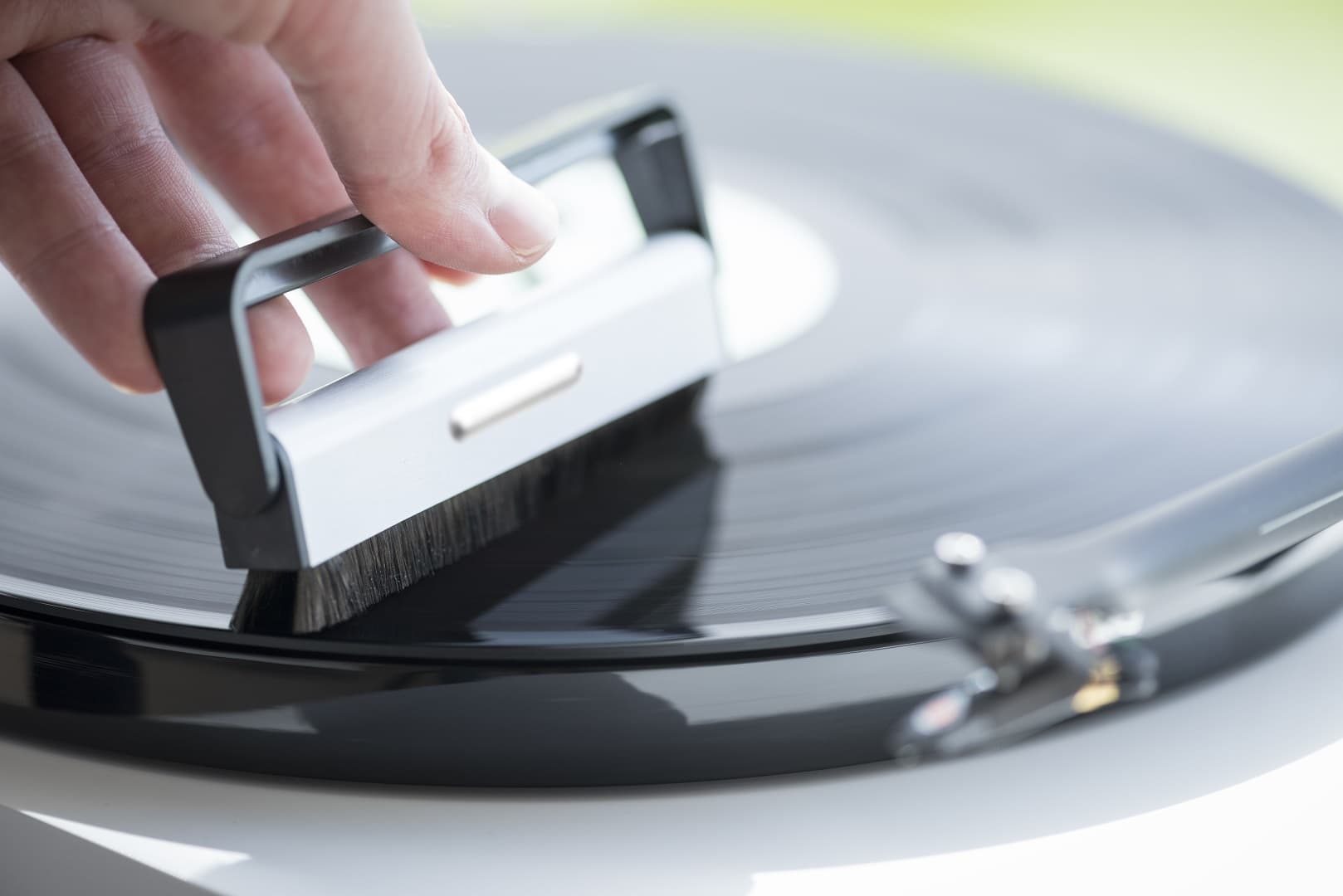
That is the entire maintenance routine. A record that is brushed before every play, handled by its edges, and kept in a good sleeve will need a deep clean very rarely. Most of record care is prevention.
Static, the reason dust will not leave
If dust seems to land back on a record the instant you have brushed it, the problem is static. Vinyl is an insulator, and the friction of sliding in and out of a sleeve, or lifting off a felt mat, builds up a charge that turns the whole surface into a dust magnet. You cannot clean your way out of a static problem; you have to discharge it.
A carbon-fiber brush helps a little, because the conductive fibers drain some charge as they sweep. Beyond that, a few things work. An anti-static gun, the best known being the Milty Zerostat, releases a stream of balanced ions when you squeeze and release the trigger; aimed at the record, it neutralizes the charge in a couple of seconds. Anti-static inner sleeves, the poly-lined kind that records should be stored in anyway, generate far less charge than plain paper. And humidity matters: static thrives in dry air, so a room that sits at a reasonable humidity rather than desert-dry will hold far less charge in the first place. Handle records by the edge and label, store them in good sleeves, and static stops being a daily fight.
When a record needs a wet clean
Reach for a deep clean in four situations, and not really otherwise.
The first is any record new to your collection, used or brand new. A used record carries whatever the last owner left in the grooves. And a new record is not as clean as it looks: pressing plants use a mold release agent, a stearate compound that lets the hot record separate from the stamper, and a thin film of it stays on the surface. It dries into a slightly sticky layer that adds noise and collects dust and stylus gunk over time. A great many people who think a new record is "noisy vinyl" are really hearing release agent. One clean when the record arrives takes care of it for good.
The second is audible noise that brushing does not fix: persistent crackle across a whole side, a hiss that sits under the music. If it is grime, a wet clean removes it. If it survives the clean, it is damage.
The third is visible dirt: fingerprints, smears, haze, anything you can see on the playing surface.
The fourth is routine upkeep, roughly every ten to twenty plays for records you spin often. There is no need to be precise about it. A record that sounds clean and lives in a good sleeve does not need a wet clean on a schedule.
The cleaning fluid: get this part right
Whatever method you use below, most of them need fluid, and the fluid matters more than the gadget.
Start with distilled water. Not tap water. Tap water carries dissolved minerals, and when it dries it leaves those minerals behind in the groove as a fine residue, which is the opposite of cleaning. Distilled water dries clean. It is sold cheaply by the gallon in any supermarket, and it is the base of every good cleaning fluid.
Water alone does not lift oils, so a cleaning fluid adds a small amount of surfactant, a wetting agent that loosens fingerprint grease and grime so the water can carry it away. This is why a dedicated record-cleaning fluid outperforms plain water. The archivists at the U.S. Library of Congress clean their disc collection with deionized water and a mild laboratory surfactant called Tergitol, which gives you a sense of what a sound fluid is: clean water plus a gentle wetting agent, and not much else.
On alcohol, the honest answer is "a little is fine, a lot is not." Isopropyl alcohol cuts grease and flashes off fast, which is why many commercial fluids and machine solutions include some. The long-running fear is that it strips plasticizers from the vinyl and leaves the groove brittle. The evidence is that this is a real risk with prolonged contact with strong alcohol, and not a meaningful one with a dilute solution used briefly and rinsed. A mix in the range of one part isopropyl alcohol to three or four parts distilled water, used quickly, is widely considered safe, and plenty of professional archives and machine makers use alcohol-based solutions. Two firm exceptions: never use alcohol on an old shellac 78, because it will dissolve the surface, and if you are unsure of a record's value or material, use an alcohol-free fluid and lose nothing.
The simplest reliable approach is to buy a dedicated record-cleaning fluid rather than mixing your own. It is inexpensive, formulated for the job, and removes the guesswork. If you do mix your own, distilled water with a tiny amount of surfactant, optionally a small share of isopropyl alcohol, is the recipe. What you should not do is reach for the kitchen: standard dish soap carries fragrances, dyes, and moisturizers that leave their own residue, and household sprays like glass cleaner contain ammonia and other chemicals that have no business near a record. More on that below.
Wet cleaning, method by method
Here are the real options, cheapest first. You do not need the expensive end. You need the one that fits your collection and how much cleaning you actually expect to do.
The manual method (roughly 15 to 30 dollars)
The entry method needs only a bottle of cleaning fluid, a soft record brush, two microfiber cloths, and distilled water for rinsing. Hold the record by the edges, or rest it on a clean towel or a platter you do not mind getting damp, and keep the label dry. Apply fluid to the surface, work it gently around the grooves with the brush following the direction of the grooves in the circular path they run, never scrubbing across them. Lift the loosened grime with a microfiber cloth, again going with the grooves. If your fluid is surfactant-heavy, follow with a second pass of plain distilled water on a fresh cloth to rinse, so no cleaning residue is left behind. Then dry it properly, which the next section covers.
This works. It is slow, it is a little fiddly, and it is entirely adequate for a collection of a few dozen records cleaned occasionally.
The bath system (roughly 80 dollars)
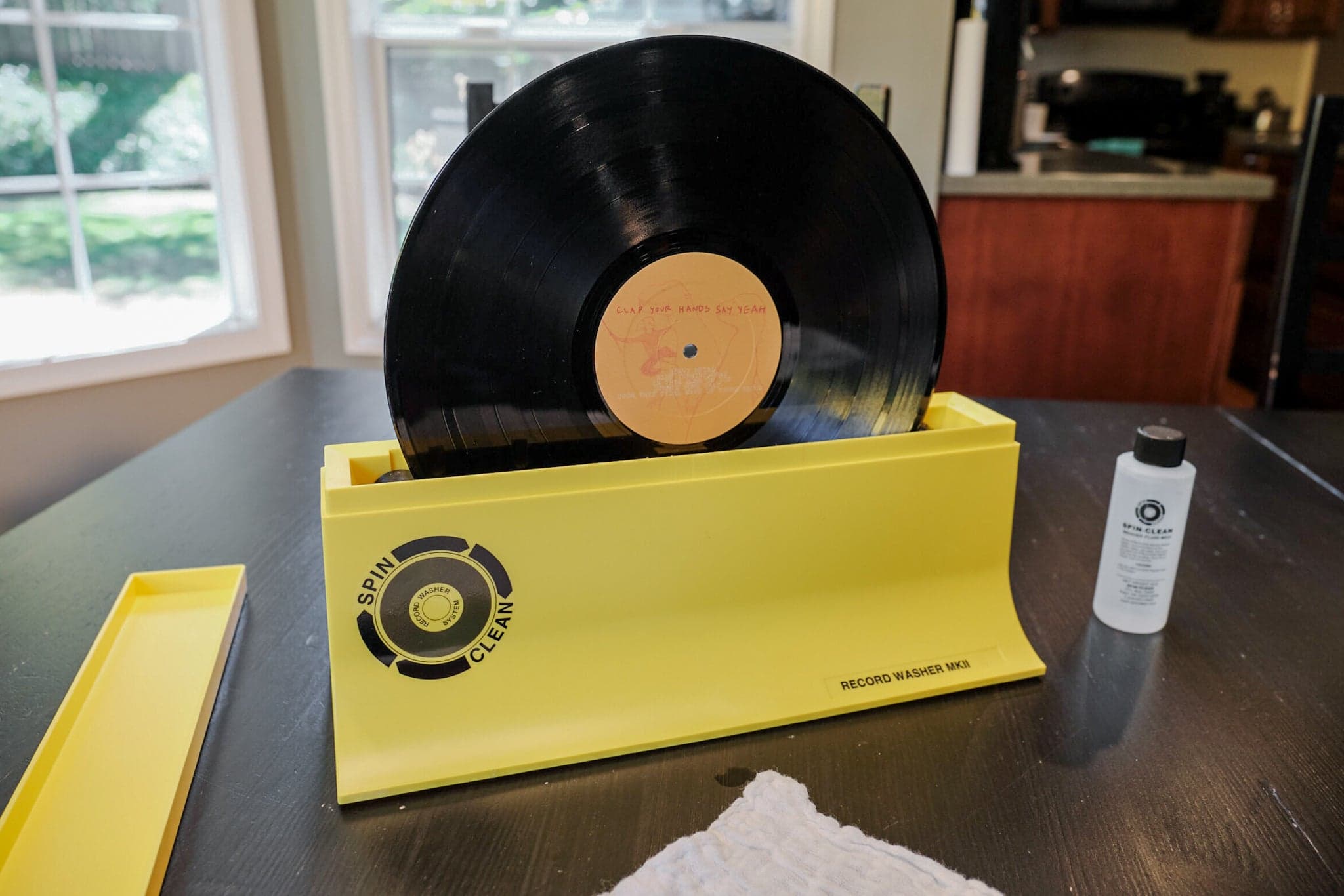
A manual bath cleaner, the long-running example being the Spin-Clean, is a small tub with two velvet brushes and a roller set. You fill it with distilled water and a capful of its fluid, stand the record in the slot, and turn it by hand a few rotations so both sides pass through the brushes at once. It cleans both sides in about thirty seconds, costs around eighty dollars, and is the standard recommendation for a collector who has outgrown wiping records by hand but is not ready to spend hundreds. Its limit is that it washes the record but does not dry it or vacuum the dirty fluid away, so good drying technique still matters.
Vacuum machines (roughly 300 to 700 dollars and up)
A vacuum record-cleaning machine, with the Pro-Ject VC-S3 the canonical example and the Record Doctor a more affordable alternative, applies fluid, lets you scrub it in with a brush, and then draws the fluid back out through a slotted vacuum arm, taking the suspended dirt with it. Pulling the dirty fluid off the record, rather than letting it dry in place, is the real advantage, and it leaves the record nearly dry in a couple of minutes. Vacuum machines clean extremely well and are fast enough for a large collection. The trade-offs are price, bulk, and noise; the vacuum is genuinely loud.
Ultrasonic machines (roughly 400 to 3,000 dollars and up)
An ultrasonic cleaner submerges the record's grooved area in fluid and uses high-frequency sound waves to create microscopic cavitation bubbles that implode against the groove walls and dislodge dirt the contactless way, with nothing physically touching the playing surface. It reaches into the groove more completely than a brush can. The category now runs from the HumminGuru, an entry ultrasonic machine around four hundred dollars that also dries the record itself, up to the Degritter and similar units that cost several thousand. Ultrasonic cleaning gives the deepest result and the least hands-on effort, and it is overkill for a small collection. For a large or serious collection, it is the method that does the most.
The honest summary: a brush plus the manual method or a bath cleaner is all most collectors ever need. Machines buy you speed, consistency, and depth. Buy up the ladder only when the size of your collection makes the cheaper methods feel like a chore.
Drying: the step people rush
A record must be completely dry before it goes back in its sleeve or onto the platter. This is not optional and it is where many otherwise careful cleans go wrong.
Trapping moisture against the vinyl in a sleeve invites mildew, which is far harder to remove than the dust you started with. And playing a damp record is genuinely bad: the stylus drags through wet grime and can grind it into the groove. Vacuum and many ultrasonic machines dry the record as part of the cycle. With every other method you dry it yourself.
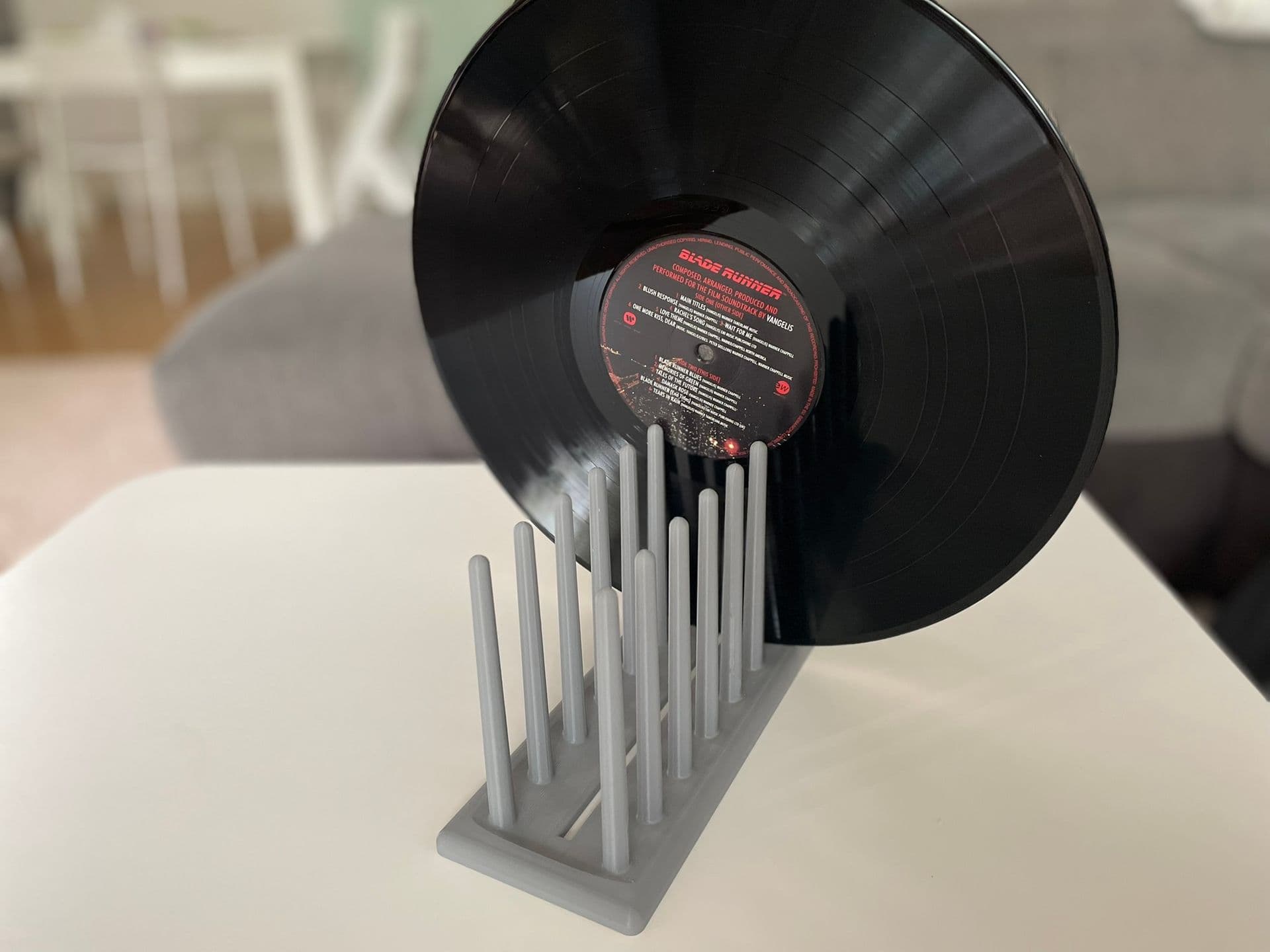
Air-drying is the safest. Stand the record on edge in a clean dish rack or a purpose-made record drying rack, somewhere dust-free, and give it a few minutes to half an hour depending on the room. If you want to speed it up, blot, do not wipe, with a clean dedicated microfiber cloth, pressing gently and letting the cloth absorb the water rather than dragging it. The one rule that admits no exceptions: never use paper towels, tissues, or any paper product to dry a record. Paper is wood fiber, it is mildly abrasive, and it sheds lint straight back into the groove you just cleaned.
Don't forget the stylus
Cleaning records while ignoring the stylus is self-defeating. The stylus is the one thing that touches every record you own, and a dirty one carries grime from record to record and drags it through the grooves. A clean record played with a gunked-up stylus does not stay clean for long.
Check the stylus often, look for a fuzzy grey ball of dust on the tip, and clean it roughly every ten to fifteen hours of play, or right after any record that was visibly dirty. The easiest tool is a stylus cleaning gel: lower the stylus gently into the gel and lift it straight out, and the dust stays behind in the gel. A dedicated stylus brush works too, used front to back, in the direction the stylus travels, never side to side. Avoid liquid stylus cleaners unless you know what you are doing, since liquid wicking up the cantilever can reach the glue that holds the stylus on. Treat the stylus as part of the cleaning routine, not a separate chore.
Difficult cases
Most cleaning is routine. A few situations need their own approach.
Mold and mildew. Records stored damp can grow mold, which looks like a white or grey haze or spotting. Spores are a genuine health irritant, so work in a ventilated space and wear gloves and ideally a mask. Loose growth can be lifted with a soft cloth first, then the record gets a normal wet clean, and the sleeve almost always has to be replaced, since a moldy sleeve will simply reinfect a clean record. Treat the cause too, which is damp storage.
Heavy embedded grime. A genuinely filthy used record may need a second pass, or a soak, before it comes clean. Patience beats pressure; scrubbing harder risks scratches without removing more dirt.
The wood glue method. You will run into this online: brush a layer of PVA wood glue across the playing surface, let it cure completely, and peel it off, lifting embedded dirt with it. It does work, and on a deeply filthy record the result can be striking. It is also slow, fussy, and unforgiving. It must be true PVA wood glue and nothing else, the glue has to cure fully or it tears and leaves residue welded into the grooves, and a mistake can ruin the record. It is a last-resort rescue for a cheap record that is otherwise unplayable, not a routine method, and never something to try first on a record you care about.
Fingerprints and small smudges. These do not need a full clean. A microfiber cloth lightly dampened with cleaning fluid or distilled water, wiped gently along the grooves, lifts a fingerprint in seconds.
What to never do
A short list of things that damage records, each of which still gets recommended somewhere online.
Never use tap water; its minerals dry into the groove as residue. Never use paper towels, tissues, napkins, or your shirt; paper and fabric scratch the surface and shed lint. Never use household cleaners, glass cleaner, all-purpose spray, or anything with ammonia or bleach; they are made for glass and counters, not vinyl, and they attack the surface. Never use ordinary dish soap with fragrances, dyes, or moisturizers; the additives leave their own residue. Never use undiluted or heavy alcohol, and never any alcohol at all on a shellac 78. Never wipe across the grooves; always follow the circular direction they run. Never play a record that is still damp. And do not over-clean: a wet clean every time you play a record is needless handling and wear. Brush before every play, deep-clean only when a record actually needs it.
A simple routine
Put together, record cleaning is genuinely simple. Brush every record with a carbon-fiber brush before you play it, and that ten-second habit prevents most problems. Give every record a proper wet clean once, when it joins your collection, with whichever method suits you, from a cloth and fluid to a machine. After that, wet-clean a record only when it sounds like it needs it or every couple of dozen plays. Always dry a record fully before it goes away. Keep the stylus clean so it stops re-dirtying everything. Store records upright in good anti-static sleeves so they stay clean between cleans. That is the whole system, and almost all of it is prevention rather than rescue.
A clean collection is partly about sound and partly about something quieter: a record you have cleaned and sleeved and shelved properly is one you can pull out in twenty years and play as if it were new. Cleaning is how a collection lasts.
Once your records are clean and your collection is logged, the question shifts from upkeep to listening: out of everything on the shelf, what do you actually want to hear tonight? That is the part Analog is built for. It connects to your Discogs collection, recognizes the record playing on your turntable and follows the tracklist, and builds listening sessions from the records you already own. Clean records, well kept, are what make a collection worth coming back to. A good guide to what to play next is what makes you actually come back to it.
If you are still building that collection, our guides to starting a vinyl collection and cataloging it on Discogs cover the ground around this one, and clean records deserve a properly adjusted deck, which the guide to setting up a turntable covers step by step.