
A record player works by dragging a tiny diamond through a groove. The groove is a physical drawing of the sound wave, pressed into the vinyl. As the record turns, the diamond, called the stylus, follows every wiggle of that drawing. The cartridge it's attached to turns the movement into a very small electrical signal. A phono preamp corrects and boosts that signal, an amplifier makes it strong enough to drive speakers, and the speakers turn it back into sound.
That's the whole chain, and nothing in it is digital. The rest of this guide goes through each step, then uses them to explain three things every record owner has heard: crackle, skips, and the last song on a side sounding a little duller than the first. At the end there's a simulation that lets you hear each of them for yourself.
The groove is the music
Each side of a record has one groove. It starts at the outer edge and spirals in toward the label, and on a twenty-minute LP side it runs for more than 400 metres.
The groove isn't smooth. Its walls waver from side to side, and that wavering is the sound itself. A loud passage swings the walls wide and a quiet one barely moves them. A low note makes long, slow curves and a high note makes tight, fast ones. If you could straighten the groove out and look at it from above, you would see the waveform of the music, the same shape you see on screen in any audio editor.
It gets there by cutting. A cutting lathe carves the groove into a blank lacquer disc while the music plays, moving exactly as the sound tells it to. Metal stampers are made from that lacquer and pressed into hot vinyl, so every copy carries the same groove. Which stamper your copy came from is part of telling pressings apart.
How one groove holds two channels
A stereo record plays a left and a right channel from a single groove with a single stylus. It does it with the groove's two walls.
Seen end on, the groove is a V. Each wall leans at 45 degrees and carries one channel: the inner wall, nearer the label, holds the left, and the outer wall holds the right. The stylus sits in the V touching both. When only the left wall moves, the stylus is pushed diagonally one way. When only the right wall moves, it's pushed diagonally the other way. The cartridge reads those two diagonal movements separately, and those are your two channels.
The system dates from the late 1950s, and it was designed so that a sound in the middle of the mix moves both walls together and the stylus goes side to side, the way it did on mono records. That's why a stereo cartridge plays a mono record without any trouble.
The stylus and the cartridge
The stylus is a polished diamond tip, a fraction of a millimetre across, on the end of a thin rod called the cantilever. The diamond rides the groove and the cantilever carries its movement up into the cartridge, the small box at the end of the tonearm.
Inside the cartridge is a very small electrical generator. In the most common design, called moving magnet, the far end of the cantilever holds a tiny magnet that sits between coils of fine wire. When the stylus moves, the magnet moves, and a magnet moving near a coil produces a current. There is a set of coils for each channel.
The signal this makes is only a few millivolts, hundreds of times weaker than what a phone or a CD player sends out. That's one of two reasons a turntable can't be plugged straight into most speakers.
Why a turntable needs a phono preamp
The other reason is that the music in the groove has been deliberately altered.
Bass takes up room. Low notes swing the groove walls wide, and a groove cut with full bass would be so broad that only a few minutes of music would fit on a side. So when a record is cut, the bass is turned down and the treble is turned up, following a standard curve called RIAA equalization that the industry settled on in the 1950s. Narrower grooves mean more music per side.
A phono preamp does the opposite on the way back: it turns the bass up and the treble down, by exactly the same amounts, so the music comes out as it was recorded. Turning the treble back down has a useful side effect. Hiss and crackle from the record's surface are mostly treble, so they get turned down too.
The preamp also raises the signal to the level an amplifier expects. Play a record without one and it sounds thin, tinny and very quiet. The preamp can be built into the turntable, the amplifier or the speakers, or be a small box of its own. Our turntable setup guide explains how to tell which you have.
What the platter and the tonearm do
Everything else on a turntable is there to let the stylus do its job.
The platter turns the record at a steady speed, 33⅓ turns a minute for an LP and 45 for a single. The speed has to be exact and even, because it sets the pitch. A platter that runs fast makes everything sharp, and one that wavers makes held notes wobble.
The tonearm holds the cartridge over the record and lets it follow the groove inward with almost no resistance. The counterweight at the back sets how hard the stylus presses down, usually between one and a half and two and a half grams. That's about the weight of a small coin, but it's concentrated on a point so small that it keeps the diamond firmly against both walls.
Why records crackle and pop
The stylus can't tell music from anything else in the groove. Whatever moves it becomes sound.
A speck of dust on the groove wall is a bump, and a bump is a click. A lot of fine dust is a steady crackle. A scratch across the grooves is a notch the stylus hits once on every turn, which is why a scratched record ticks in rhythm: once every 1.8 seconds at 33⅓.
Dust comes off, and our guide to cleaning vinyl records covers how. A scratch is part of the groove now, and no cleaning removes it.
Why records skip
A skip is the stylus leaving its groove and landing in the next one, or the one before.
Two things cause it. The first is a jolt: a knock on the furniture or a heavy footstep on a wooden floor lifts the stylus for an instant. The second is too little tracking force. If the stylus presses down too lightly, a loud passage can throw it clear of the wall. A deep scratch can do the same, and when it sends the stylus back into the groove it just played, you get the same two seconds over and over.
Why the last song on a side can sound duller
The record turns at the same speed from start to finish, but the groove doesn't pass under the stylus at the same speed. A turn at the outer edge is about 90 centimetres of groove. A turn near the label is closer to 40. Both go by in the same 1.8 seconds.
So at the edge the groove moves past the stylus at about 50 centimetres a second, and near the label at about 20. The same second of music has to fit into less than half the length. The wiggles for high notes get squeezed so tightly that the tip of the stylus, small as it is, can no longer follow them exactly. Cymbals and the top of a voice lose some of their edge.
It's one reason albums are often sequenced with the loud, bright songs early on a side and a quieter one at the end.
Hear it for yourself
Guillermo Rauch has built a record player you can run in your browser that doesn't play audio files. It turns a recording into the shape of a groove, then moves a simulated stylus along the walls 384,000 times a second and plays you the signal a cartridge would make from that movement.
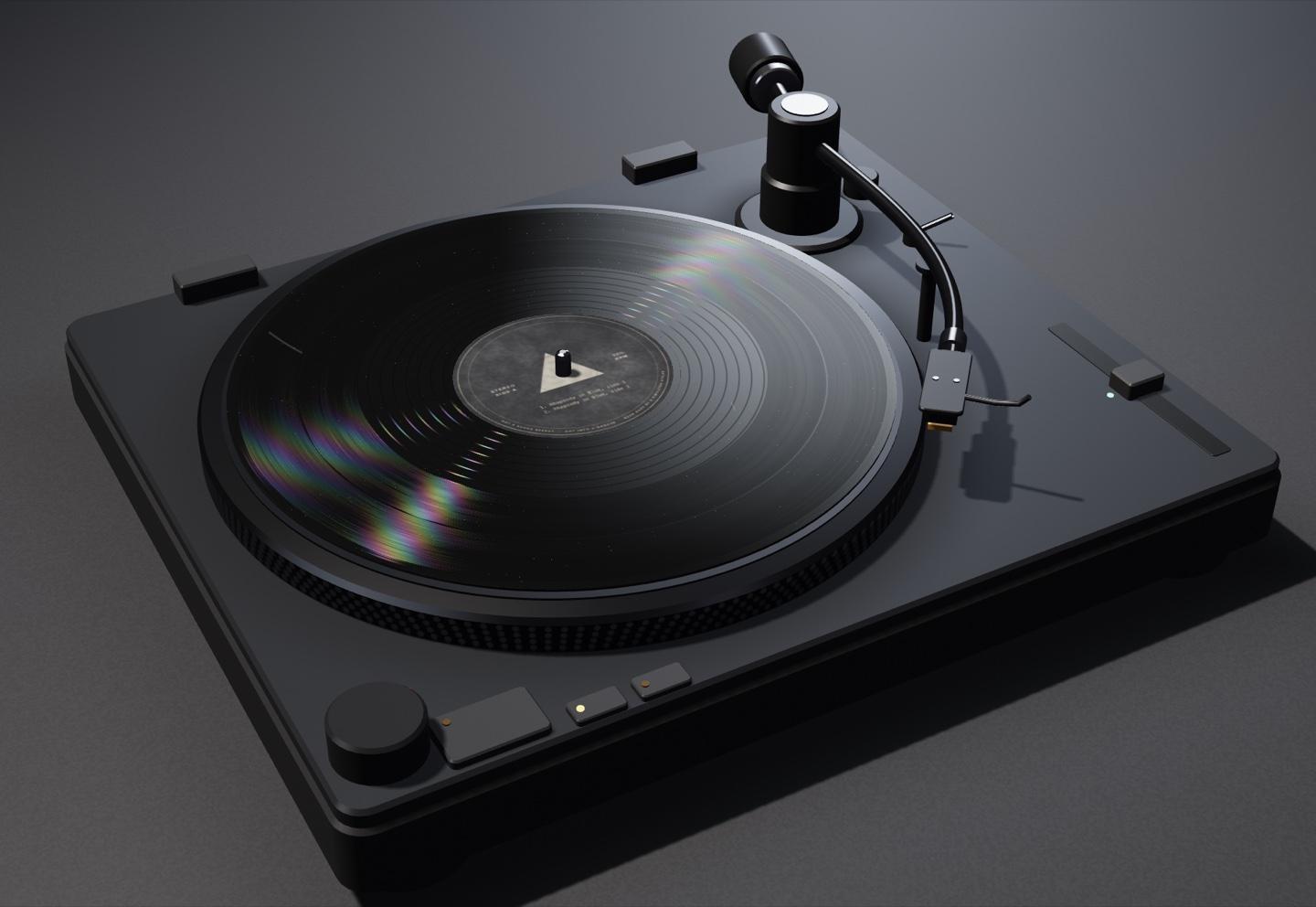
Because the crackle, the skips and the dull inner grooves aren't added as effects, you can cause each of them yourself. Open Controls and press a dirtier copy of the record, and the crackle gets worse. Lower the tracking force until the stylus starts to leave the wall. Drop the needle near the label and compare the treble with the outer edge. Zoom in and you can watch the stylus in the groove while it plays. The code is open if you want to see how it's done.
What this means at home
Once you know the stylus plays whatever is in the groove, most record care makes sense. Keep the groove clean and you remove the crackle. Set the tracking force properly and put the turntable on something solid, and it stops skipping.
Knowing which record is on is a different problem, and it's the one I work on. Analog, the app I make, listens while a record plays, recognises which record from your Discogs collection it is and which side, and follows it on your phone. The record player still does the hard part, the same way it has since the 1950s.