
To host a vinyl listening party, invite four to eight people, tell them the format before they come, and plan the evening in sides rather than albums. Put the turntable somewhere nobody will bump it, keep the drinks on another surface, and decide early how the next record gets chosen. That last part matters more than the snacks or the speakers. There is one turntable and everyone has an opinion, and a night where one person chooses everything is just that person's playlist with friends in the room.
Records help you here. A side lasts about twenty minutes and then stops until someone gets up, so the evening comes with its own breaks to refill a glass and decide what goes on next.
This guide covers each of those decisions in order. Near the end I explain how Analog, the app I make, lets your friends browse your shelf and pick from their phones.
How many people to invite
Four to eight is the comfortable range. With fewer than four it's an evening with a friend, which is lovely but needs no planning. Past eight or ten, people split into groups and stop listening, and the wait for a turn gets long.
Don't worry about whether your guests own records. Most of your friends probably don't have a turntable. They still have albums they love and opinions about what to play, and that's all the night needs.
Choose a format
Tell people the format in the invitation. "Come over for records on Saturday" works for two friends. For six, a line about how the night will run saves a lot of standing around at the shelf.
One album, start to finish
Everyone listens to the same record, both sides, with a break at the flip. It's the easiest format to host, and it works best for a new release people have been waiting for, or an album half the room knows by heart and the other half has never heard properly. Name the record in the invitation so people arrive curious, and ask for attention while it plays. The conversation can wait for the flip, which is never more than twenty minutes away. When the album ends, open the shelf up and let the rest of the evening run looser.
One side each
Everyone picks a record from your shelf, but only one side of it. Then it's the next person's turn. On r/vinyl, a host described a dinner run this way: each guest "chooses a record from my collection, but only gets 1 side", twenty-two records over the day. Another member replied that they play the same game at home and call it choose a side.
It's a small rule and it does a lot. Turns come round every twenty minutes, so nobody waits long. Nobody can take over the room with a double album. And picking which side to play is a good decision to watch someone make. People talk through this kind of night, and that's fine. Keep the volume where the music is still clearly the main thing.
This is the format I'd suggest for a first party, because it works with any group and any collection. It's also the one Analog Jukebox was made for, which I'll come to below.
Bring a record
Each guest brings one or two records from home and says a line about why before it goes on. You hear music you don't own, and the stories make people listen more closely.
It only works if most of your guests have records. If half of them don't, mix it with the format above: those who brought something play a side of it, and everyone else picks from your shelf.
Give the night a theme
A theme isn't required, but it narrows the shelf and makes choosing easier. The ones that work are simple: a decade, debut albums, film soundtracks, records you bought this year, or albums from the year everyone in the room turned eighteen. Keep it loose. If someone wants to play a record that doesn't fit, let them.
How many records you need
Count in sides. A side of a 12-inch LP runs about eighteen to twenty-two minutes, so with the changeovers you get through roughly three sides an hour. A three-hour evening is about nine sides. Four hours is about twelve.
That tells you how the turns will go. Six people playing one side each takes two hours, which leaves time for a second round. Twelve people would wait four hours between turns, which is why the guest list has a limit.
You don't need to pull records in advance, but it helps to stand ten or so that you'd love to hear at the front of the shelf. People choose faster when a few are already facing them. Our guide to building a vinyl listening session has more on putting an evening's records in order.
Set up the room
A turntable that never skips when you're alone can skip all night with eight people in the room. The cause is usually the floor. Footsteps travel through wooden floorboards into the furniture, and the stylus jumps. Before the party, put the turntable on the heaviest, most solid surface you have, against a wall, away from where people will walk. Keep it off the furniture the speakers sit on, too. Our turntable setup guide explains why and what to do if your floor is especially springy.
Drinks go on a different surface from the turntable and the records. Say it once at the start. Leave space next to the turntable for the sleeve of the record that's playing, or it ends up on the dust cover.
Turn the main light off and use lamps, and set the volume a little higher than you would on your own, because a room full of people absorbs sound. Two people sitting next to each other should still be able to talk without leaning in.
Before anyone arrives, play one side all the way through. It's the quickest way to find out that the stylus needs a brush, a speaker cable has come loose or the volume is wrong.
Who handles the records
Decide this before the first guest reaches for a sleeve. You can do every change yourself: friends choose, you put it on. It's the safest for the records, but you'll be up every twenty minutes.
Or you can show people how, once, at the start. Hold the record by its edge and the label, never by the playing surface. Lower the needle with the cue lever instead of by hand. When the side ends, the record goes straight back into its inner sleeve. Most people are careful once they've been shown, and putting a record on themselves is something guests remember.
If friends bring their own records, look at each one in the light before it goes on your turntable. A dusty charity-shop find can clog the stylus within a side. A pass with a carbon fibre brush is usually enough. If it's really dirty, keep it for another night and clean it properly first.
Decide how the next record gets picked
This is the part most hosting advice skips, and it's the one that goes wrong. Without a system, whoever is standing nearest the shelf chooses, the quieter guests never get a turn, and you spend the night refereeing.
The simplest fix is to go round the room in order, and to say so at the start of the night. Everyone knows when their turn is coming and has twenty minutes to think about it, and once there's a rule, asking for a record stops feeling like pushing in.
Going round the room still has limits. Your friends can't see your whole collection from the sofa, so they pick from the dozen sleeves they can reach. The person whose turn it is ends up standing at the shelf while everyone waits. And you're still the one in the middle, keeping track of who's next.
Let friends pick from their phones
That's the problem I built Analog Jukebox to solve. It's part of Analog, an app for people who keep their record collection on Discogs, and it lets everyone in the room browse your records and queue a pick from wherever they're sitting.
You open a Jukebox in Analog on your iPhone, iPad or Mac, and it shows a code. Leave it on the screen next to the turntable, or share the invitation in your group chat. Your friends scan the code with their phone's camera. They don't install anything or create an account: on an iPhone it opens as an App Clip, and on any other phone as a web page. They type a first name and they're in.
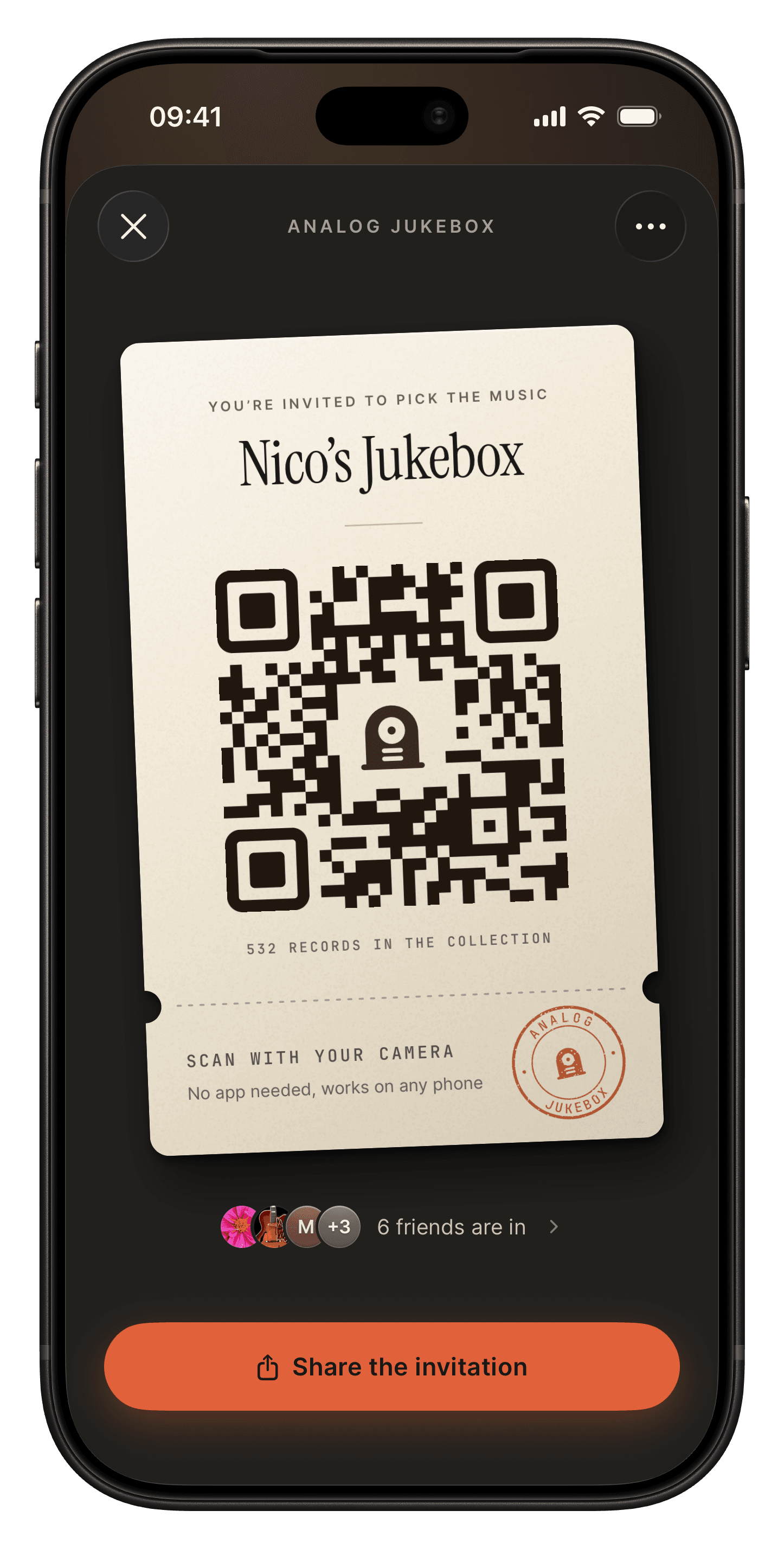
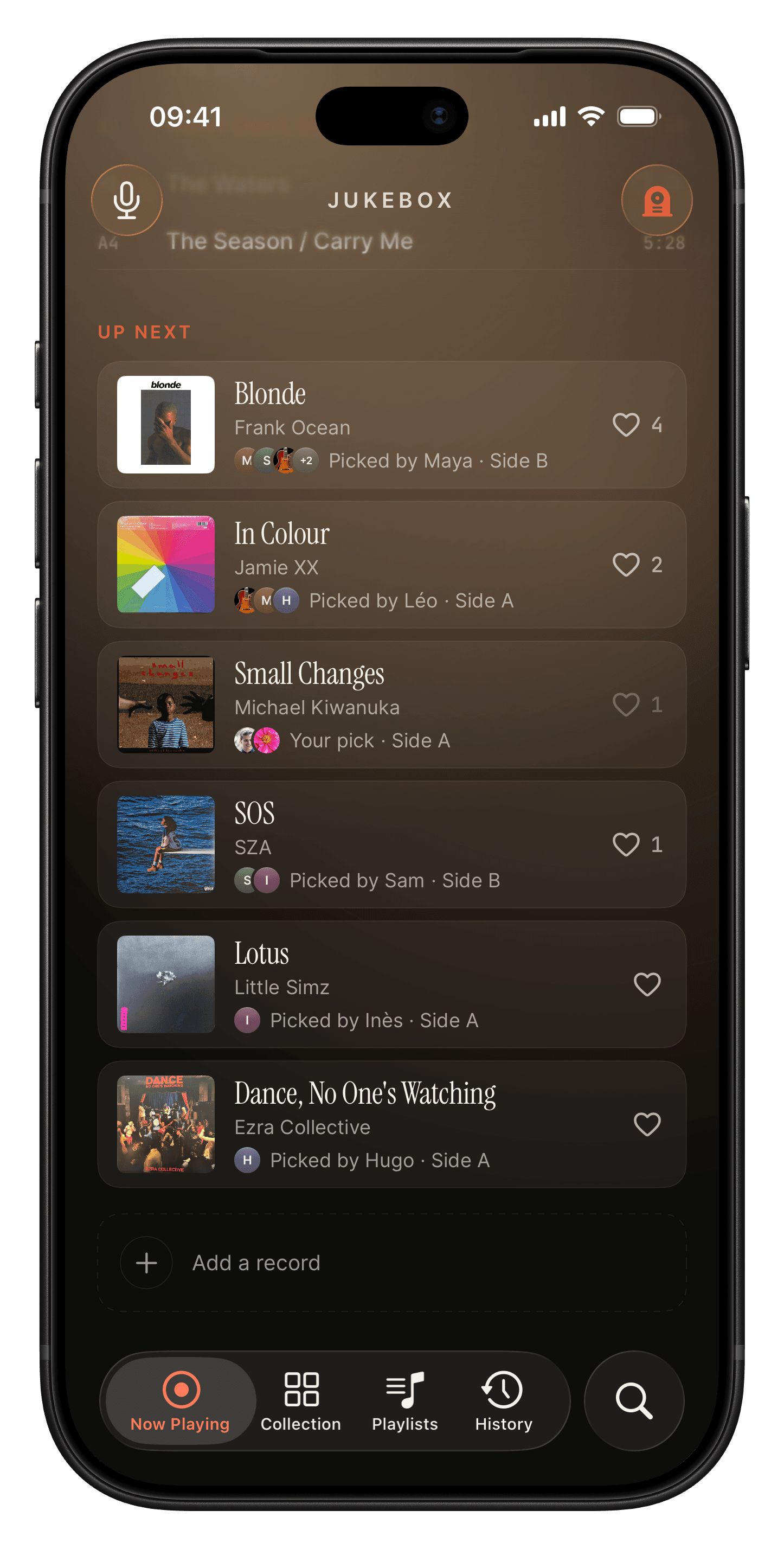
From there, each friend can browse your whole collection with the covers, open a record to see its sides and tracks, and pick the side they want to hear. The pick goes into Up Next with their name on it, and everyone sees the same list on their own phone.
The order isn't first come, first served. Anyone can heart a pick they'd like to hear too, and the picks with the most hearts move up. So the room decides what plays next. You keep the last word. You can drag a record up or down the list or remove a pick, and the list stays in the order you set.
You don't have to watch your phone while this happens. Each new pick appears on your Lock Screen and on your Apple Watch. When you put a friend's record on, Analog recognises it and their phone tells them their pick is on.
If the room fills up, you can lock the Jukebox so nobody else can join. Last call stops new picks, which is a polite way to end the night. Afterwards you can keep the evening as a playlist of what was played, and it goes into your History in Analog. The Jukebox itself, with your friends' names and picks, is deleted from Analog's servers within twelve hours.
For a themed night, you can open the Jukebox from a playlist you made earlier, so the evening starts with your picks and your friends add theirs.
Being a guest is free. Hosting is part of Analog Studio, the subscription that also builds listening sessions from your records. It costs $4.99 a month or $29.99 a year, and the yearly plan starts with a seven-day free trial, which is long enough to host one party and see how it goes. Analog needs your collection on Discogs, since that's the shelf your friends browse. If yours isn't there yet, start with our guide to cataloging a vinyl collection.
Make it a regular thing
The first one takes the most thought. After that the format is settled and all you need is a date, so set the next one before everyone leaves.
Write down what went over well, or keep the playlist if you used the Jukebox. Somewhere in that list are records you'd forgotten you owned. Put one on later in the week, when the house is quiet again. And if you find yourself back at the shelf with no idea what to choose, we have a guide to picking a record for tonight.