
Pull two copies of the same album off two different shelves and you may be holding two genuinely different records. A first pressing from the year of release and a reissue from four decades later can differ in mastering, sound, packaging, value, and collectibility. They share a title and a cover. Almost everything else can be different.
Knowing which pressing you own is one of the quiet pleasures of collecting, and it is practical too: it tells you what a record is worth, hints at how it will sound, and lets you catalog your collection accurately. This guide walks through every clue collectors and dealers actually use, in the order you should check them, and finishes with an honest note about what these clues can and cannot prove.
Why the pressing matters
An original and a reissue of the same album can be worth wildly different amounts, sometimes by a factor of ten or more. They can also sound different: pressed from different masters, at different plants, on different vinyl, decades apart. None of that is visible from the front of the sleeve. To know what you actually have, you have to look closer.
It is worth saying up front that "first pressing" is a slippery phrase. Collectors use it loosely, and for many albums the very first run was itself spread across several plants in the same week, each with its own slightly different stampers. The goal here is not to win an argument about who pressed the truest first copy. It is to identify your specific release accurately, so your catalog is correct and you know what you have.
Start with the catalog number
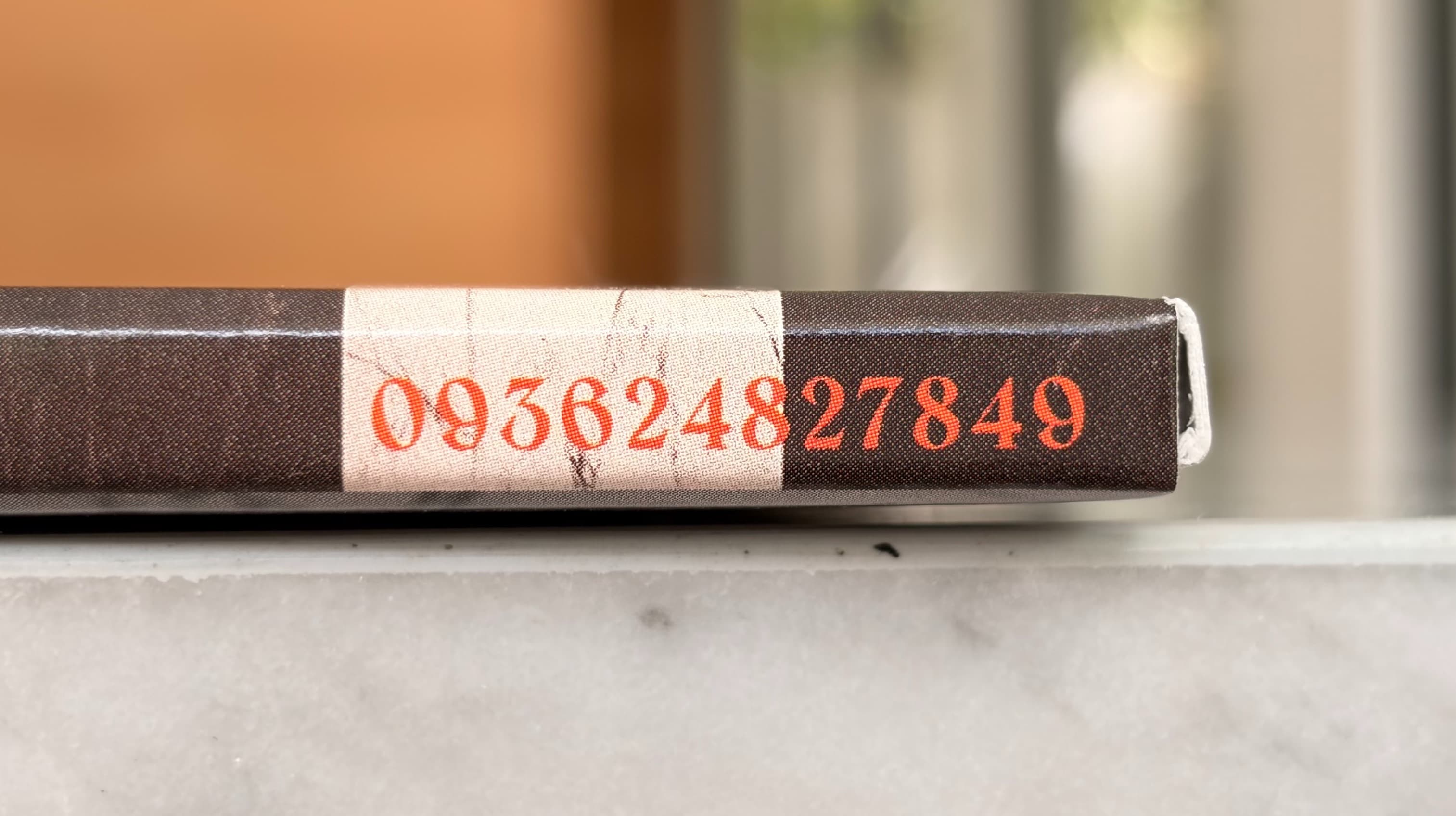
Every release carries a catalog number, the label's own reference for that specific issue of the record. You will find it on the label, usually near the spindle hole, and on the sleeve, typically on the spine and back cover.
When an album is reissued, it almost always gets a new catalog number, or a recognizable variant of the old one. So two copies with different catalog numbers are, by definition, different releases. It is the first and easiest thing to check, and it narrows the field before you do any closer inspection.
Read the deadwax
The deadwax, also called the runout or the matrix area, is the smooth ring of vinyl between the last groove and the label. Etched or stamped into it is the matrix information, and it is the closest thing a record has to a fingerprint.
The codes are shallow and often faint, so light matters. Hold the record almost flat and tilt it under a single light source so the beam rakes low across the surface. The raised and recessed characters will catch the light and become readable. A small flashlight or your phone's torch held at a steep angle works better than overhead room light.
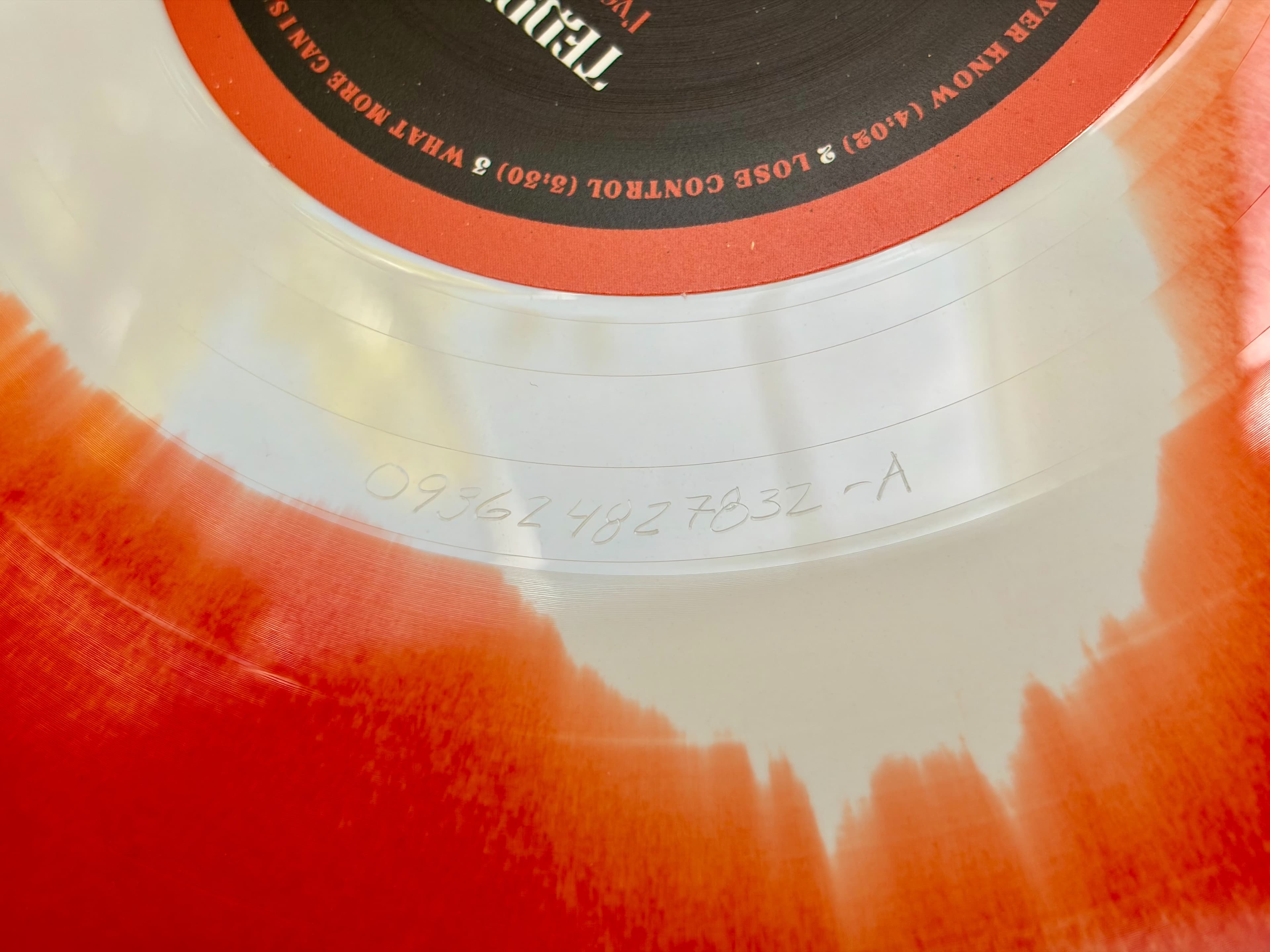
Then read both sides separately and write down exactly what you see, including every letter, number, space, dot, and stray symbol. Side A and side B usually carry different matrix strings, and the punctuation is part of the identifier. A transcription that drops a space or a dash is a transcription that will match the wrong release on Discogs.
Inside the deadwax you may find several distinct things:
The matrix number itself, which ties the disc to a specific master and side. It often echoes the catalog number with a side indicator added. Many matrix strings also carry a small suffix, sometimes a digit or a letter, that records which lacquer cut or take was used. As a rough rule, a lower cut number points to an earlier lacquer, so a side stamped "1" or "1A" was cut before one stamped "4". This is one of the clues that separates an early copy from a later repress made from a fresh lacquer.
Pressing-plant and stamper codes, which tell you where the record was physically made. Plants used recognizable marks: "MO" for Monarch, "PR" or "PRC" for Presswell, "CTH" for the Columbia plant at Terre Haute, "SS" for Specialty Records Corporation, among many others. The same album pressed at two plants in the same month counts as two different versions on Discogs.
Mastering engineer marks, which are the runout's most quietly famous detail. Some engineers signed their work, and collectors learned the initials. "RL" is Robert Ludwig. "BG" is Bernie Grundman. "TJ" is Ted Jensen. The hand-etched "Porky" or the phrase "A Porky Prime Cut" is George Peckham. Spotting a known engineer can date a pressing and, for certain records, raise its value, because particular cuts developed a reputation among listeners.
Here is how it comes together. A runout reading something like "ST-A-691671-A RL SS" can be unpacked as the label and side prefix, the matrix number, the side letter, the engineer (Robert Ludwig), and the plant (Specialty). You do not need to decode every record this thoroughly. You just need to copy the full string accurately so you can match it later.
One more visual tell: how the characters were made. Hand-etched, slightly irregular scratching is common on older and earlier pressings. Clean, uniform, machine-stamped characters point toward a later pressing or a modern reissue. It is a soft signal, not proof, but it is a useful first impression.
Check the label
A record label's artwork is not fixed. Logos, fonts, rim text, and color schemes change over the years, and a given design belongs to a specific era. Experienced collectors can date a pressing from the label alone.
Look for the label design and logo variant, since labels often went through several distinct looks across a single decade. Check whether it reads "STEREO" or "MONO", because mono pressings of older records are frequently the more collectible of the two. Note any promo markings, such as "Demonstration, Not For Sale" or a distinct white or gold promo label, which mark a copy sent out before general release. And read the small print, including rights-society text and address lines, which gets revised over time and can pin down an era.

Look at the sleeve and the small print
The packaging carries dating clues too.
Barcodes are the clearest. They did not appear on records until the late 1970s and were not widespread until the mid 1980s. A barcode on an album originally released before then is a strong sign you are holding a later pressing or a reissue, not an early original. Country-of-manufacture text, the "Made in" line, tells you where the record was pressed and narrows the release further. And modern reissues tend to announce themselves on hype stickers and back covers with phrases like "180-gram", "remastered", or "limited edition".
Match it on Discogs
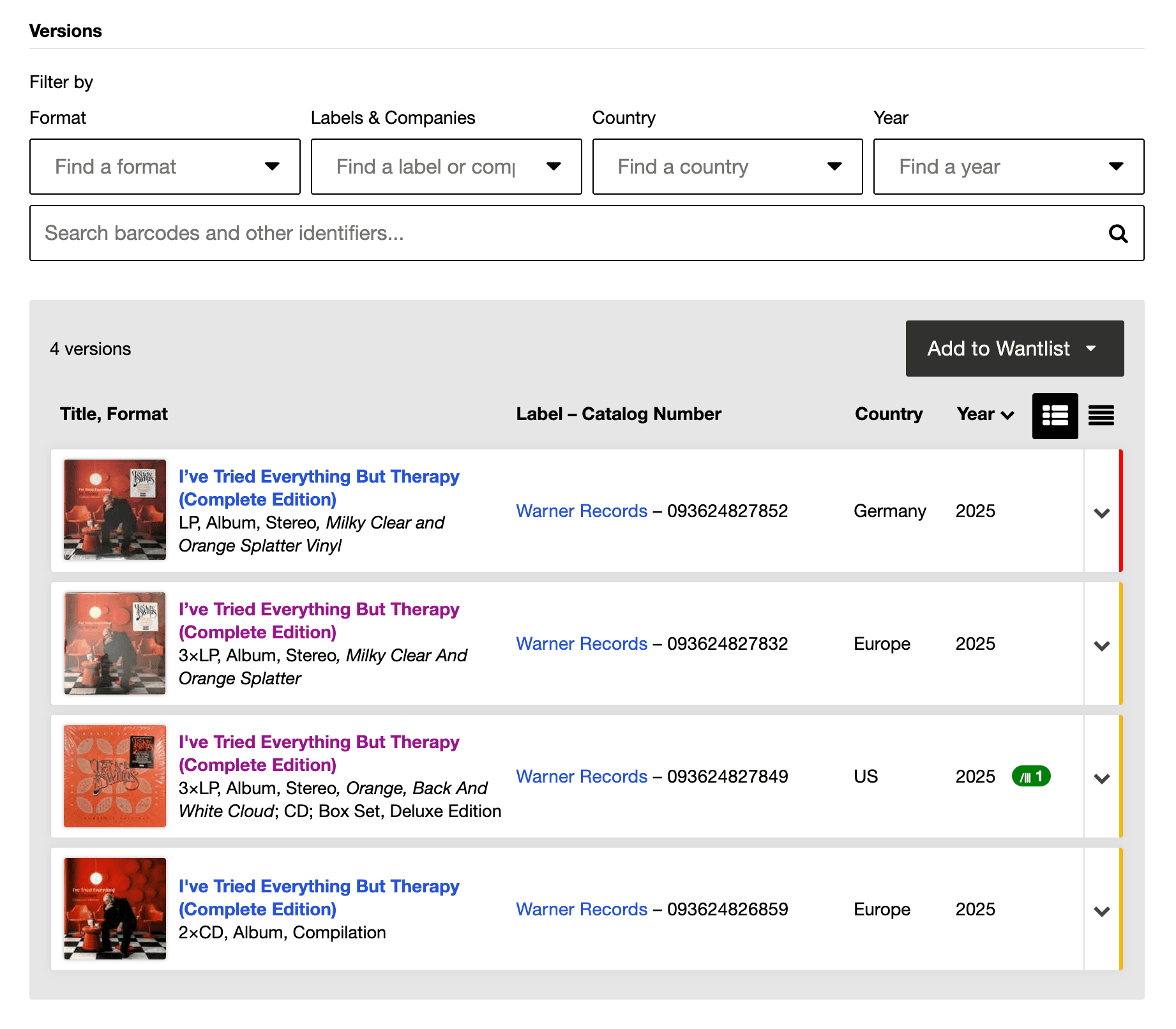
This is where the clues come together. Discogs catalogs releases at the level of the individual pressing: every version of an album is listed separately, each with its own catalog number, country, year, label, and matrix details.
Find the album's master page, then open its list of versions. Now match what you have in your hands against the list: your catalog number, the matrix strings you transcribed from each side of the deadwax, the country, the label variant, the presence or absence of a barcode. Work down the list until one version lines up with your record on every detail. Pay particular attention to the runout fields, since two versions that look identical on catalog number alone are often told apart only by their matrix strings. When everything agrees, that version is your pressing.
If a record predates Discogs-era cataloging or is poorly documented there, the site 45worlds is a useful second reference, especially for older 78s, 45s, and LPs where collectors have logged label and runout detail.
This kind of release-level matching is exactly what Discogs was built for, and it is why serious collectors keep their collections there. A record logged in your Discogs collection is not just "the album". It is the precise pressing you own.
First pressing or reissue: the quick read
If the one question you care about is "original or reissue", a few signals get you most of the way. A barcode generally means a reissue for anything released before the 1980s. The words "remastered", "180-gram", or "reissue" printed anywhere on the packaging are self-explanatory. A catalog number or label design that postdates the album's original release year points to a later issue. And a deadwax full of clean, machine-etched modern matrix codes, rather than irregular hand-etched ones, leans the same way.
No single one of these is decisive on its own. Together, they usually settle it.
It is worth being honest about the limits here. A matrix number by itself is not proof of a first pressing. Early matrix codes were reused, repressed, and copied across plants, and a low cut number tells you a lacquer was cut early, not that your particular disc came off the press first. Treat the deadwax as strong evidence to be weighed alongside the label, the sleeve, and the Discogs match, rather than as a verdict on its own. Identification is the accumulation of agreeing clues, not a single magic code.
Why getting this right is worth it
Identifying your pressings is satisfying on its own, the detective work that comes with collecting. But it also makes your collection genuinely useful as data. An accurately cataloged Discogs collection knows what your records are worth, and it powers the tools you use to enjoy them.
Analog is one of those tools. It connects to your Discogs collection and turns it into a companion for actually listening: it recognizes the record on your turntable, follows the tracklist as it plays, and builds listening sessions from records you already own. It leans on your Discogs collection being accurate, which is one more reason the deadwax detective work pays off.
So the next time you slide a record from its sleeve, give the runout a tilt toward the light. It has a story to tell about where your copy came from.