
To keep a log of the records you play, write down one line each time you put a record on: the day, the record, and the sides you heard. That can live in a notebook by the turntable, in Last.fm alongside everything you stream, or in an app that logs the records for you. The format matters less than you'd think. What decides whether a log survives past the first month is how much effort each line costs, so the best method is the one you'll still be using in March. Here is how each one works, what's worth recording, and what a few months of lines will tell you about your shelf.
Why keep one
Streaming keeps a history whether you want one or not. Every service knows what you played last Tuesday, and most of them turn the year into a recap in December. A turntable keeps nothing. The record goes back in its sleeve and the evening leaves no trace, which is part of the charm until you try to remember the last time you played something.
A log fixes that, and it tends to surprise people. The records you think of as favourites are not always the ones you play. A handful of albums take most of the evenings, and a long tail of records you were excited to buy sits untouched for a year. You can't see that from the shelf. You can see it after a month of writing things down.
What to write down
The date, the record and the sides are enough. The sides matter more than they look. Most records are played a side at a time, and plenty of evenings are one side of something before bed, so "played Swimming" and "played side C of Swimming" are different nights. If you own more than one pressing of an album, note which copy, the same way you'd tell them apart on Discogs.
Anything beyond that is optional. Some people add a line about where they were or who was there, which makes the log read like a diary a few years on. Others note the length of the side so they can add up the hours. Decide before you start, because a log whose columns change every week is hard to read back.
One choice to make early is what counts as a play. The simplest rule is that a record counts once each time it goes on the platter, however many sides you hear, and again if you come back to it after something else. Two sides of Swimming on Monday are one spin, and side C of it on Friday is another. Count that way and a record's play count means what it sounds like.
In a notebook
A notebook is the oldest method and still a good one. It sits next to the turntable, it needs no battery, and writing a line while the first track starts becomes part of putting a record on, the way cleaning it is. Rule four columns down the page (date, artist, record, sides) and leave a margin for notes.
The weakness is reading it back. A notebook is easy to fill and slow to search: counting how often you played one record means scanning every page, and spotting the records you never played means checking the whole shelf against it. If what you want is the diary, that's fine. If you want the numbers, you want something that counts for you.
Scrobbling to Last.fm
If you already use Last.fm, you may want your records in the same place as everything you stream. Last.fm calls each logged track a scrobble, and it collects them automatically from Spotify, Tidal, Deezer and its own desktop and mobile apps, but nothing tells it when you put a record on. So vinyl gets scrobbled by hand. Open Scrobbler, a free and open-source web tool, is the usual way: you search for the album, pick the tracks you heard, and send them to your profile, and it can look releases up on Discogs.
The reward is one history for everything, with Last.fm's charts and year-end numbers built in. The cost is the same as the notebook's: you still have to remember, track by track or side by side, every time, and a scrobble records the music but not that it came off a turntable.
Apps that log it for you
Every manual method has the same weak point, which is you. The log is only as complete as your memory on a tired Thursday, and the evenings when you're most absorbed in the music are the ones you're least likely to stop and write down. That's why a lot of play-logging apps exist. Most of them work like a quicker notebook: you open the app and tap the record you're playing, often from your Discogs collection. That's quicker than a notebook line, but it's still a step to remember.
Analog, the app I make, takes that step away. It listens to the record on the turntable, finds it in your Discogs collection down to the side, and follows it on your phone, the Lock Screen and Apple Watch; our guide to the app that tells you what record is playing explains how. Since version 3.0 every side it identifies also goes into History, so the log keeps itself. History adds up your time at the turntable for the month, the year or since your first record, shows a bar for each day that you can slide across, lists your most played records, and keeps every day's listening with the sides you played. A record your Apple Watch identifies lands in the same log.
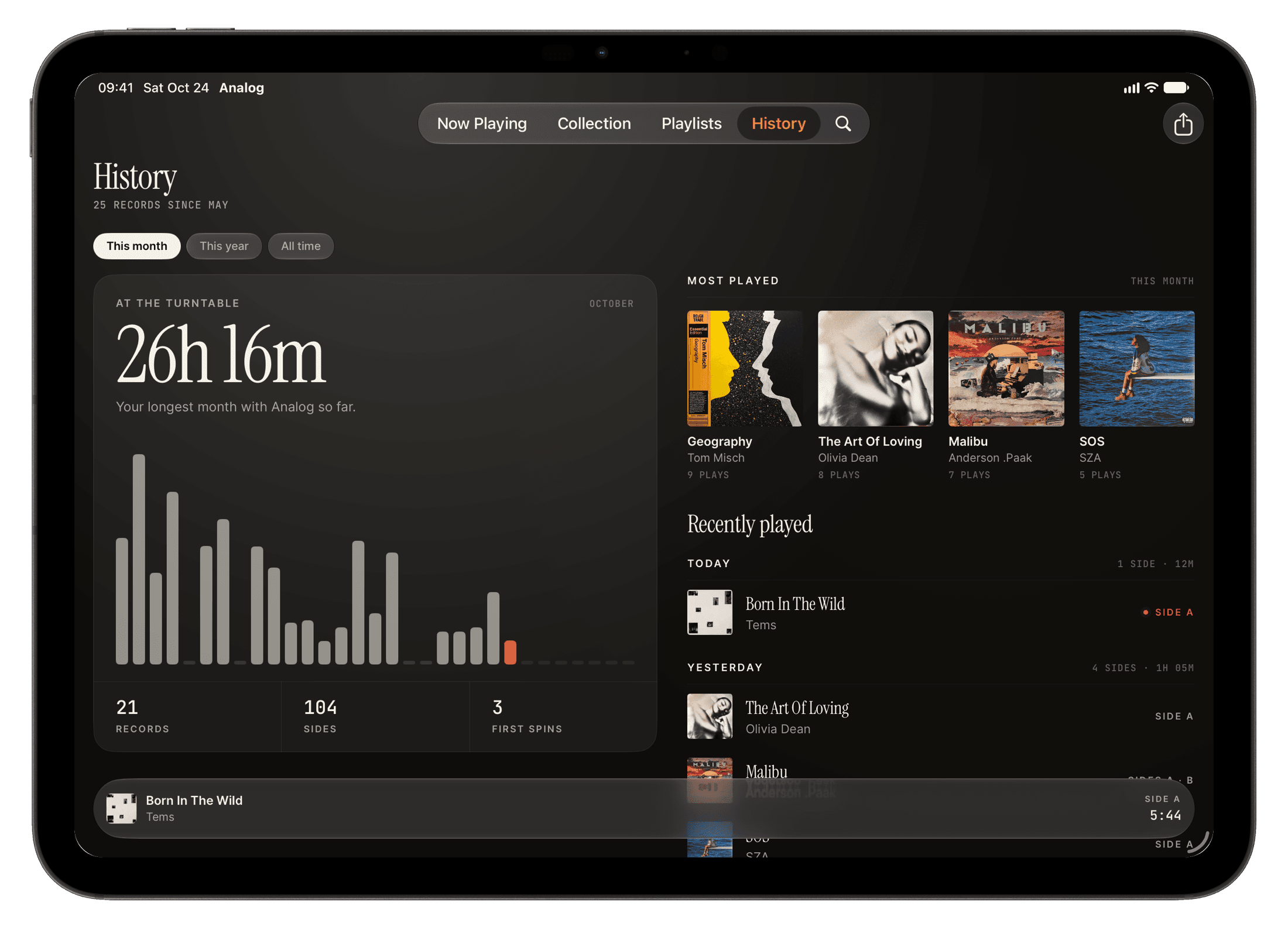
It counts the way the diagram above does: sides heard back to back are one spin of the record, and coming back to it later is another. At the end of the month you can turn it into a card, your most played records and your hours, to share or save to Photos.
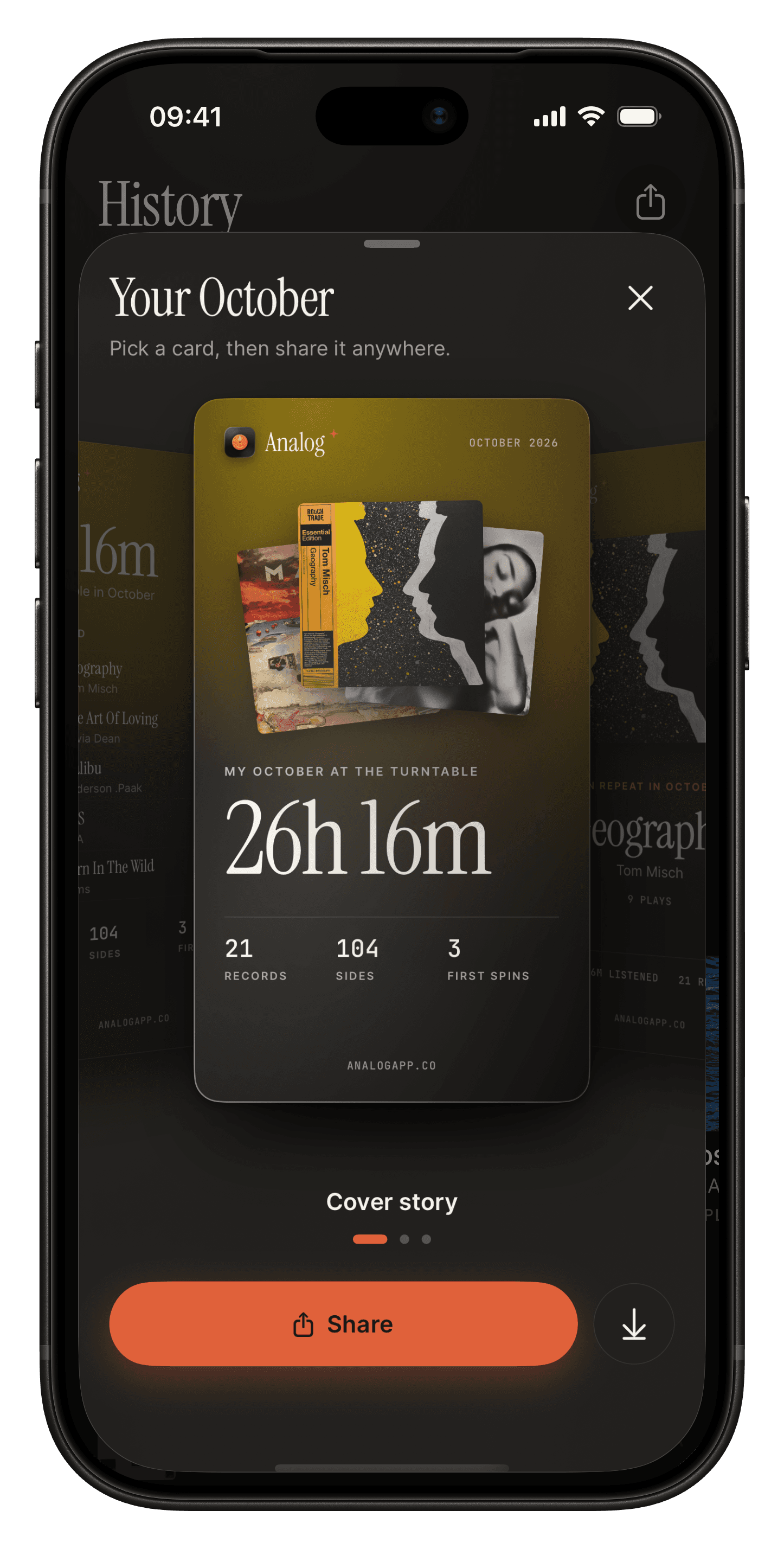
History is part of the free app, along with identifying records and the follow-along. It has the limits you'd expect from something that listens. It only logs what it heard, so a record played while the phone was in another room isn't in it. A record you mark as playing from a session's Up Next counts, but there's no way to add a past evening by hand. The record has to be in your Discogs collection, with its tracklist filled in, since that's what Analog follows; our guide to cataloging a vinyl collection on Discogs gets it there. If you play records the phone can't hear, a notebook next to it fills the gaps.
Reading your log
A log earns its keep when you read it back, and once a month is about right. Look at which records took most of your evenings, and whether that's what you'd have guessed. Look at the records you haven't played at all, the ones that never show up in the log. And add up how much time you actually spent listening, which is usually less than it feels like and sometimes more.
The missing ones are the useful part. They're the records you chose for a reason and then forgot, and a short list of them is the easiest answer to standing in front of the shelf with no idea what to put on. Pull one out next time, or build an evening around a few of them; our guide to building a listening session is a good place to start. Analog's Play Next picks, the few records it suggests beside whatever's playing, come from your own shelf too.
Keep it easy
Start with whatever is closest to hand. A notebook by the turntable tonight beats a perfect system you'll set up next weekend, and three columns beat ten. If you find you love the diary and never look at the numbers, stay with paper. If you find you keep forgetting to write things down, let something else do the remembering. Either way, a few months from now you'll know your collection a little better than you do today, and you'll probably have played a few records you'd forgotten you owned.