
Most evenings with records go one of two ways. Either you put something on, it ends, you stand in front of the shelf for a while, and you put on the same thing you played last week. Or you decide, before anyone has sat down, what the next hour or two is going to sound like: three or four records that go together, the sides you actually want to hear, in an order, with the flips landing somewhere you were going to get up anyway. The second kind of evening is what I mean by a listening session, and it takes about five minutes of thought to set up. This is how I'd go about it, and how Analog, the app I make, can do the remembering for you once the records are playing.
Think in sides, not albums
A side of a 12-inch record runs somewhere around eighteen to twenty-two minutes, and then the music stops until you get up. Streaming never makes you think about that. A turntable makes you think about it every twenty minutes. So when you plan an evening, the side is the thing you're counting, not the album. An hour is three sides. A dinner is three or four. A double album on its own is most of an evening.
Counting in sides also frees you up. You can play the second side of one record and the first of another. You can keep a session to an hour without stopping a record in the middle of a song. And a flip stops feeling like an interruption and starts feeling like a pause you can use.
There's a good reason to play sides whole, too. Artists who care about vinyl sequence for it. Colin Meloy of The Decemberists has written that the band's early albums were sequenced for CD, so their side breaks are "bizarre, lumpy, ungainly", and that on the newer record "the sequencing for our new record is very meticulous about its side breaks" (Kill Your Shuffle Button, January 2024). When an album is built like that, the last song on side A and the first on side B are a pair, and the minute you spend turning the record over is part of the design.
Start with the evening, not the shelf
The mistake is to walk up to the shelf and look for something to play. Four hundred records all at once is too many choices, so you reach for the same ten you always reach for, or you lose the first twenty minutes deciding.
Start with what's actually happening. Who's here, what are you doing, and how long have you got? A slow Sunday morning with coffee is two or three quiet sides. Cooking is a side of something with a bit of movement, then whatever goes with the food. A dinner is three or four sides, warm, not too loud, nothing that asks the table to stop talking. Late at night on your own, it's two sides of something you want to actually listen to. Once you know that, the number of sides is settled, and the mood has already narrowed the shelf to a corner. Picking from twenty records is easy. On an ordinary night with time for one record rather than an evening, the same idea works for a single pick, and what record to play tonight goes through it.
Decide how many sides before you decide which ones. For most evenings that's somewhere between two and six. Fewer than two is just a record. More than six and nobody is listening any more, which is fine at a party but is a different thing.
Picking the records
Pick one record first: the one you most want to hear tonight. That decision does most of the work. It sets the tone, and everything else only has to belong in the same room as it.
Then look for records that share something with it. The same few years, the same label or city, a producer, a tempo, a feeling. Two records you bought on the same trip. The link doesn't have to be clever and nobody else needs to see it; it just needs to be there, so the second record picks up where the first left off instead of changing the subject. What you want to avoid is the opposite pair of problems: two sides by the same artist back to back, which flattens things, and four records that all sound alike, which is just one long record.
Put in one record you haven't played in a year. Every collection has a working rotation of fifteen or twenty records and a hundred more that wait. Planning an evening is the best excuse I know to bring one of them down, and when you've got the first two slots filled around your anchor, the third is where the half-forgotten one fits. It's usually the one you remember afterwards.
And pick sides, not albums. If side one is the one that works tonight, play side one and put the record away. Side two will be there next week. Letting a double album run all the way through because it happens to be on the turntable is how a planned evening turns back into background music.
Putting them in order
The order is simple to get right once you think of the evening as having a shape. Open with something easy to walk into, a side whose first track settles the room without demanding anything. Put the record you most wanted to hear in the middle, when everyone's there and paying attention. End with a side that lets things down gently, so the last time you lift the needle it feels like a landing and not a stop.
Then look at the joins. The last track on one side and the first on the next are a pair you're putting together, the same way the artist paired the two halves of their own album. A quiet closer into a loud opener is a jolt. Sometimes that's what you want, mostly it isn't. If a side ends on a long slow song, the next side can open with a pulse and the room lifts. If a side ends loud, give the next one a slower start.
Two things matter at the joins, tempo and loudness. Key and genre matter less than people think. A pop record and a jazz record sit together fine if the energy carries across the flip. Two records in the same genre will fight if one is mastered much louder than the other and somebody has to get up and turn the amp down. Which is worth knowing in advance: part of planning the order is knowing which records need a hand on the volume.
The flips
The flip isn't a problem to solve. Every twenty minutes the music stops, you stand up, and for a minute the room is just people talking. That pause is the best thing the format has over a playlist, and a session that puts the flips in the right places feels unhurried in a way a playlist never does. Put them between courses, at the end of a chapter, when the coffee needs a refill.
A few small habits make them smooth. Have the next record out of its sleeve and leaning against something before the side you're on runs out, so the change takes thirty seconds rather than three minutes of searching. Know roughly how long the side runs, so the run-out groove doesn't catch you at the stove. If the record's a gatefold, leave it open on the table so the next side's tracklist is right there. And decide beforehand whether you're flipping to side B or changing records, so the end of a side is a move you already know and not a decision you make standing up with the tonearm in your hand.
This is also the part a phone can genuinely help with, and the part I'll come back to: knowing where you are on the side, how long is left, and what's next.
The room
You don't need good gear for this. You need gear that isn't getting in the way. The turntable is set up properly, tracking force and anti-skate where they should be, which takes ten minutes once; our guide to setting up a turntable walks through it. The stylus is clean and the records you're about to play have been brushed, because an evening of attentive listening is exactly when a dusty record is most annoying; how to clean vinyl records covers that. And the volume is set for the room and the company before the first side starts, not fiddled with through the first three songs.
Then the room itself. Lights a bit lower than you'd have them for reading. Phone somewhere other than your hand. If people are coming, chairs facing more or less the same way, which sounds fussy and makes a surprising difference: a room arranged around the speakers listens differently from a room arranged around the television. None of this is ceremony for its own sake. Records ask for a little attention at the edges, and that's what lets the middle of the evening look after itself.
With friends
The easiest way to do this with other people is to have everyone bring a record. Home & Texture wrote up the format as a bring-your-own-vinyl night (Vinyl Listening Parties Are The New Night In): set a theme so the choice is narrow, and near the end go round the room and have each person say why they brought what they brought. The theme does the same job it does when you're on your own. It turns an impossible choice into an easy one, and it gives the records a reason to be in the same evening.
Two rules keep it together. One side at a time, whole: the host sets the order and nobody lifts the needle to skip a song, because the reason you're all here is to give the records the attention a playlist never gets. And talk between sides rather than over them, as far as the company allows. That second rule is what separates a listening session from a party with music on, and it's worth saying out loud at the start so nobody feels shushed later. The flips give everyone a minute to say what they thought, and the next side starts when the host drops the needle.
There are more people doing this than there used to be. In the US, vinyl grew for the nineteenth year running in 2025 and passed a billion dollars in revenue, according to the RIAA's year-end report. A lot of those records get bought as objects. An evening like this is where they get played.
Where Analog comes in
Everything above works with a pen and the back of an envelope. What an app adds is the bookkeeping: remembering the order, knowing where you are on a side, telling you what's next, and, when you don't have the time or the appetite to choose, doing the choosing from your own shelf.
Analog starts from your Discogs collection, so it already knows your records, their sides and their tracklists. The session builder, Analog Studio, asks about the evening first, the same way this guide does: an occasion (slow morning, cooking, dinner party, late night), a mood, the genres it found in your collection, and a line in your own words if you want to steer it.
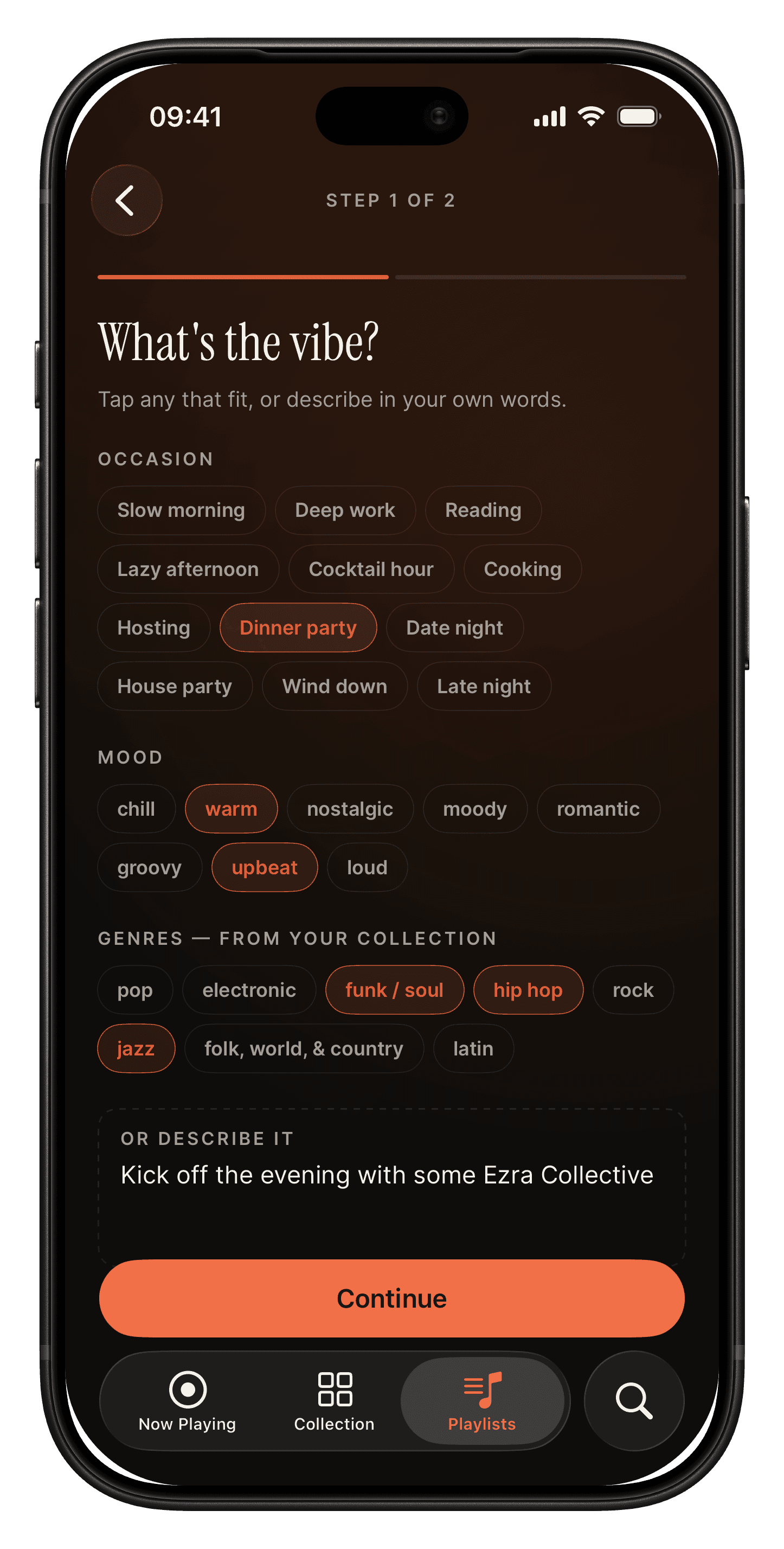
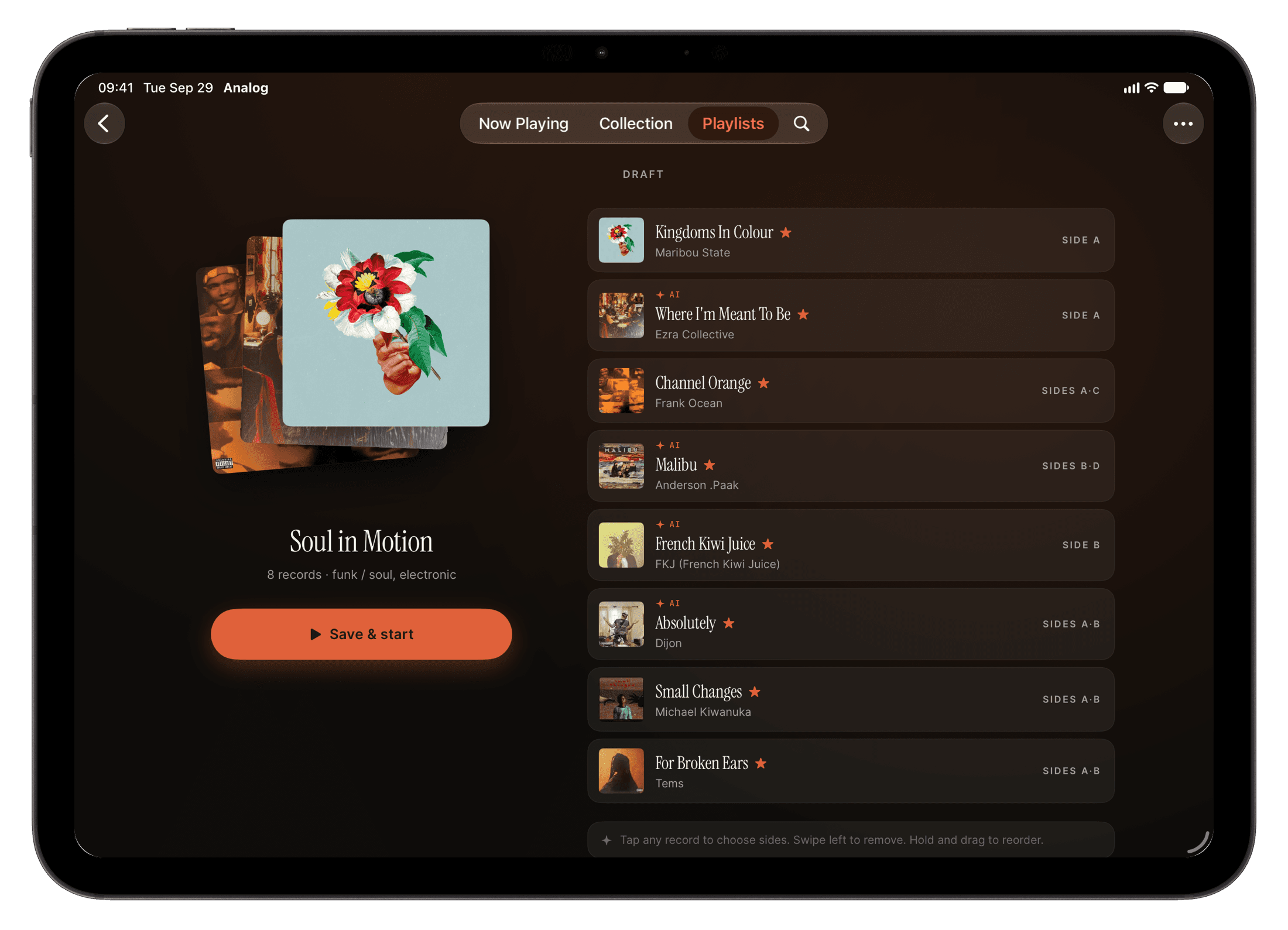
Then you tell it how long you've got, and it drafts a session from records you own: which records, which sides, in what order, with an opener, a middle and a landing. You can also hand it a few records you already know you want to hear and let it fill in around them, which is the anchor method with the rest of the choosing done for you. The draft is yours to change. Tap a record to pick its sides, swipe one away, hold and drag to reorder, then save it and start.
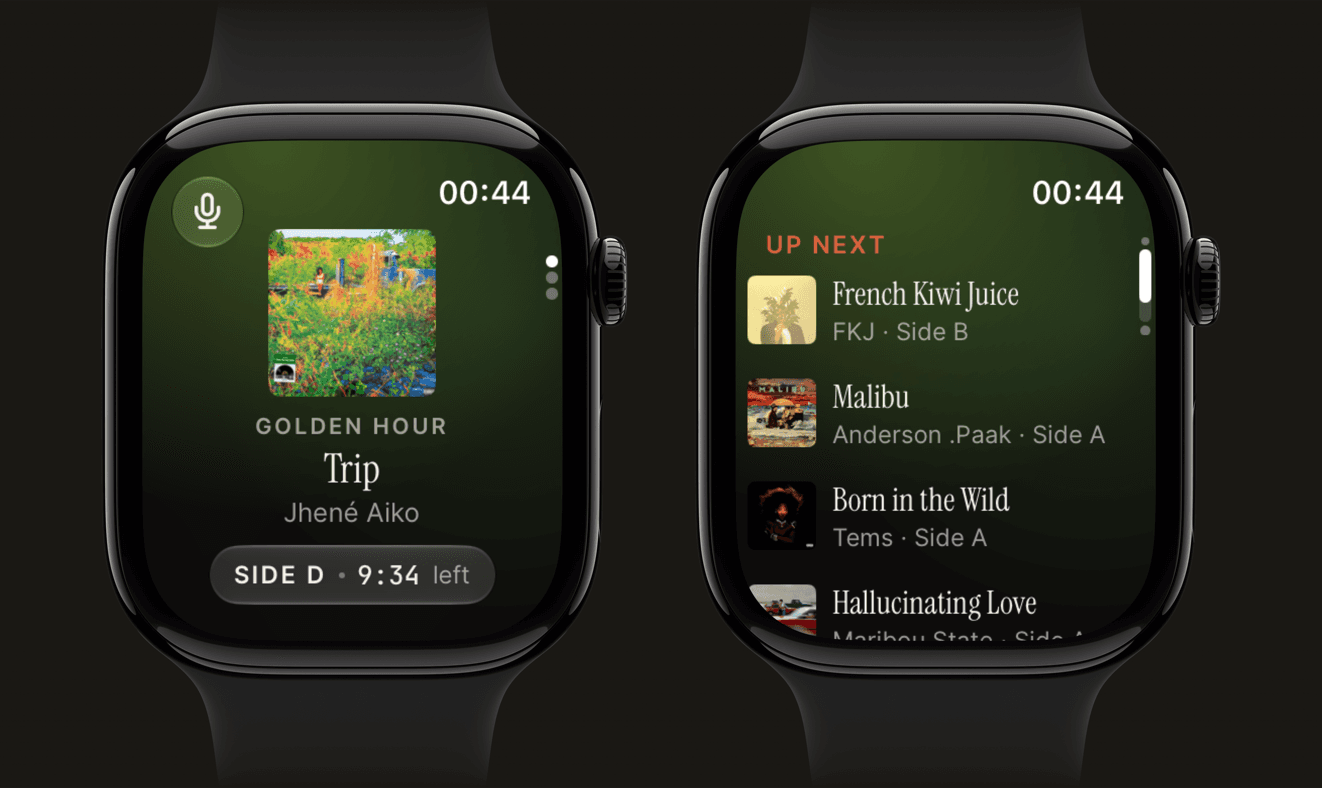
Once the session is running, Analog follows along. Put the first record on and it hears it, finds it in your collection, and shows the side, the track that's playing and how long is left, on the phone, on the Lock Screen, in the Dynamic Island, and on Apple Watch if you wear one. Under the tracklist is Up Next: the rest of the session, record and side, in order, so the next change is a move you already know. On the watch the same side and countdown are on your wrist, with the next records a page over, which turns out to be the most useful place for them when you're at the stove or across the room. Our guide to the app that tells you what record is playing goes into how the listening works and what it needs.
Without a session running, Analog still suggests what to play next: beside whatever's on, it offers a few picks from your own collection, so the end of a side is a decision already half made. That part is free, along with identifying records, the follow-along and the watch app. Studio, the subscription, is what gives you unlimited AI-built sessions and saved sets, at $4.99 a month or $29.99 a year with a seven-day free trial on the yearly plan. It needs your collection on Discogs, with each record matched to the right pressing and its tracklist filled in, because the tracklist is what it follows. If yours isn't there yet, our guide to cataloging a vinyl collection on Discogs is the place to start.
Three evenings to try
To make this concrete, here are three shapes that work, with the number of sides and where the flips fall. Fill them from your own shelf.
A slow morning, three sides, about an hour. Open with the quietest side you own that still has songs on it, something you can make coffee to. Second side, the one you wanted to hear. Third, a side that keeps the mood but adds a little movement, so the morning ends on its feet. The flips fall at the second cup and at the point where you start thinking about the day.
A dinner, three sides, just under an hour. First side on before anyone sits down, warm and unobtrusive. Second side with the food, the record people will ask about. Third side as the plates clear and the wine comes out, slow and generous. Two changes, each at a moment when you were going to stand up anyway. If the evening runs long, a fourth side is an easy yes.
A late night on your own, two sides, forty minutes. One record, both sides, start to finish. Pick the one you've been meaning to sit with, turn the lights down, and give it the attention the morning and the dinner couldn't. The one flip is the only pause, and it's a good one.
Hearing more of your collection
The evenings are the point, but the habit does something to the collection too. Records that have waited two years come down and get heard. Keeping a log of the records you play shows you which ones have been waiting. The same fifteen stop standing in for the whole shelf. After a few months of this, the collection feels like something you use rather than something you look at. A listening session is just a few records, a bit of thought about the order, and the decision to stay with them. Everything else, the app included, is there to make it easy to do again tomorrow.