
Ask yourself two things before you look at the shelf: how long you have, and what you played last. The first tells you whether tonight is one side or a whole album. The second gives you somewhere to start, because the easiest record to choose is one that has something in common with the record you just took off. If that still leaves a tie, play the one you haven't heard in the longest time, or let chance pick between two or three. That's most of it. The rest of this piece is about why the shelf makes it hard, and the few habits that make it easy.
Why a full shelf is hard to choose from
A collection of three hundred records is three hundred good answers, and that's the problem. Nothing on the shelf is wrong, so nothing stands out, and after a minute of looking you put on one of the ten records you always put on. The ten are fine. But the reason you buy records is to have the other two hundred and ninety, and they mostly sit there.
The famous research here is the jam study: in 2000, Sheena Iyengar and Mark Lepper set up a tasting stand in a California grocery store with either six jams or twenty-four, and shoppers who saw the smaller display were far more likely to buy a jar (Journal of Personality and Social Psychology). It's often taken to mean that more choice is always worse. It isn't that simple. A 2010 review of fifty experiments found that on average the number of options made almost no difference, with a lot of variation from one study to the next, and that people who already knew what they wanted did fine with a big selection (Scheibehenne, Greifeneder and Todd, Journal of Consumer Research). That second finding is the useful one. The shelf isn't too big. You just walked up to it without a question.
So the trick is to bring one. Each of the habits below is a different question you can ask, and any one of them turns three hundred records into five.
How long have you got
A side of a twelve-inch LP runs somewhere around eighteen to twenty-two minutes, and that's the unit to count in, not the album. Twenty minutes before you have to leave, or before dinner, is one side. An hour is three. A free evening is an album or two, played all the way through.
This narrows things more than you'd expect. With twenty minutes, you're not looking for a record, you're looking for a side, and plenty of records have one side you love more than the other. With a whole evening, it's the moment for the double album you never start because it asks for eighty minutes. And with an hour and a few people over, it's no longer one choice but a short sequence, which is a different job, and the guide to building a listening session covers it.
Knowing the time also stops the most common way a night of records goes wrong, which is putting on something long and slow when you only had half an hour, and lifting the needle halfway through side A.
Start from the last record
The record you just played is the best clue you have. It already set the mood of the room, and the next one only has to carry on from it, or turn away from it on purpose. Either way you're choosing in relation to something, not from nothing.
The easiest thread to follow is the people. Turn the sleeve over and look at who's on it: the guest singer on track three, the producer, the drummer. There's a good chance one of them has a record of their own somewhere on your shelf, and it's a natural next step, because you've just heard them on someone else's record and liked what they brought to it. The credits on the back of the sleeve, or the release page on Discogs, will give you more of these than you'll ever use.
The other obvious thread is the sound itself: something that feels like the record you just heard, without being more of the same artist. And the threads work the other way too. If the last record was loud and busy, the thread might be "the opposite of that", and the opposite of a dense rap record isn't nothing, it's a quiet one with space in it.
What to avoid is the same artist twice in a row. It feels like a natural choice and it rarely is: the second record sounds like more of the first, and both lose something.
Give the forgotten records a turn
Every collection has a working rotation, the fifteen or twenty records that get played, and a much larger shelf that waits. Some of what waits is there for a reason. A lot of it is there because you bought it, played it twice, and then it got pushed along by whatever you bought next.
When two records are equally good choices for tonight, play the one you heard least recently. That one rule, applied every time there's a tie, is enough to keep the whole collection moving. If you want to be more deliberate, keep a short stack of records you've decided to bring back, and take the next one from the stack whenever the other habits leave you undecided. Rediscovering a record you'd forgotten you owned is one of the best things a collection can give you, and it only happens if something makes you reach past the usual ten.
It helps to know what you've actually been playing, because memory is bad at this. A note inside the sleeve works, and so does a log of the records you play, which shows you at a glance that a record you love hasn't been on the turntable since spring.
Let chance decide the last step
Random choice has a bad reputation among collectors, because a random pick from the whole shelf is how you end up with a Christmas record in July. Used for the last step only, it's very good. Narrow the shelf with a question first, how long, what came before, what's been waiting, until you have three or four records that all fit. Then stop deliberating and let a coin, a dice roll or whoever's in the room pick one.
If your collection is on Discogs, the app can do the coin's job: open your collection and shake your phone, or choose "Random item from Collection", and it picks a release for you (Discogs). It knows nothing about tonight, so treat its pick as a suggestion you're free to ignore.
The point isn't that chance chooses well. It's that once every option fits, the time spent choosing between them is time you're not listening, and the record you didn't pick will still be there tomorrow.
When the side ends
The hardest moment to choose is the one with the least time: the run-out groove is ticking, the room has gone quiet, and you have to decide now. That's when people reach for the usual ten. So decide early. Somewhere around the last two songs of the side, pick the next record, pull it out and lean it against the shelf. If you've got the threads in mind, it takes a few seconds, and the change of record becomes a short pause instead of a search.
How Analog helps
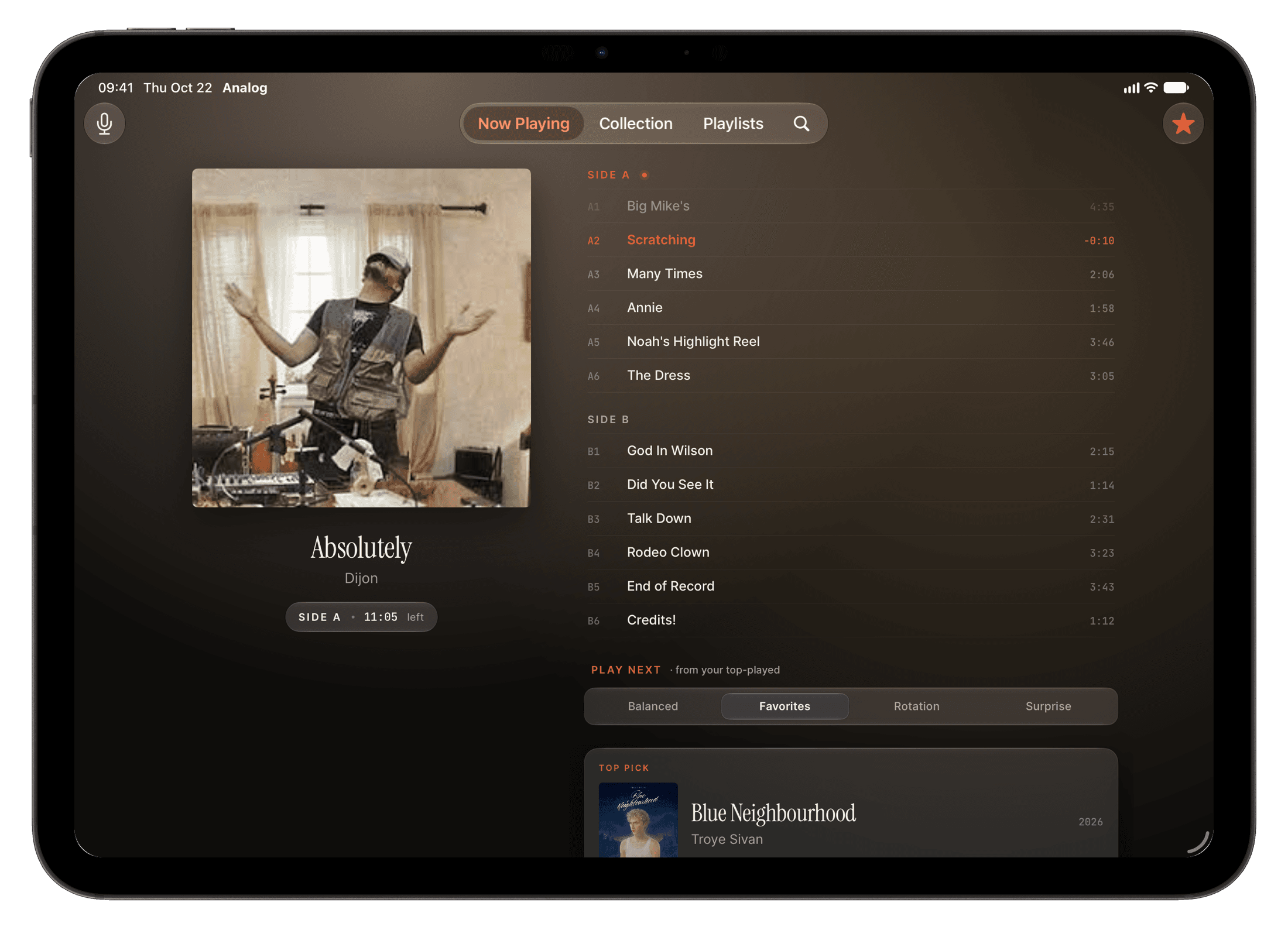
This is the moment I built Analog around. It listens to the record you put on, finds it in your Discogs collection and follows the side as it plays. Beside the record that's on, Play Next suggests what to put on after it, from your own shelf and nowhere else: a top pick with a line on why, and two more. You choose how it leans: toward your favourites, toward records that have sat on the shelf, toward the less familiar ones, or a mix of all three, which is the default. Play Next is worked out on the phone with Apple Intelligence, so it needs a device that supports it.
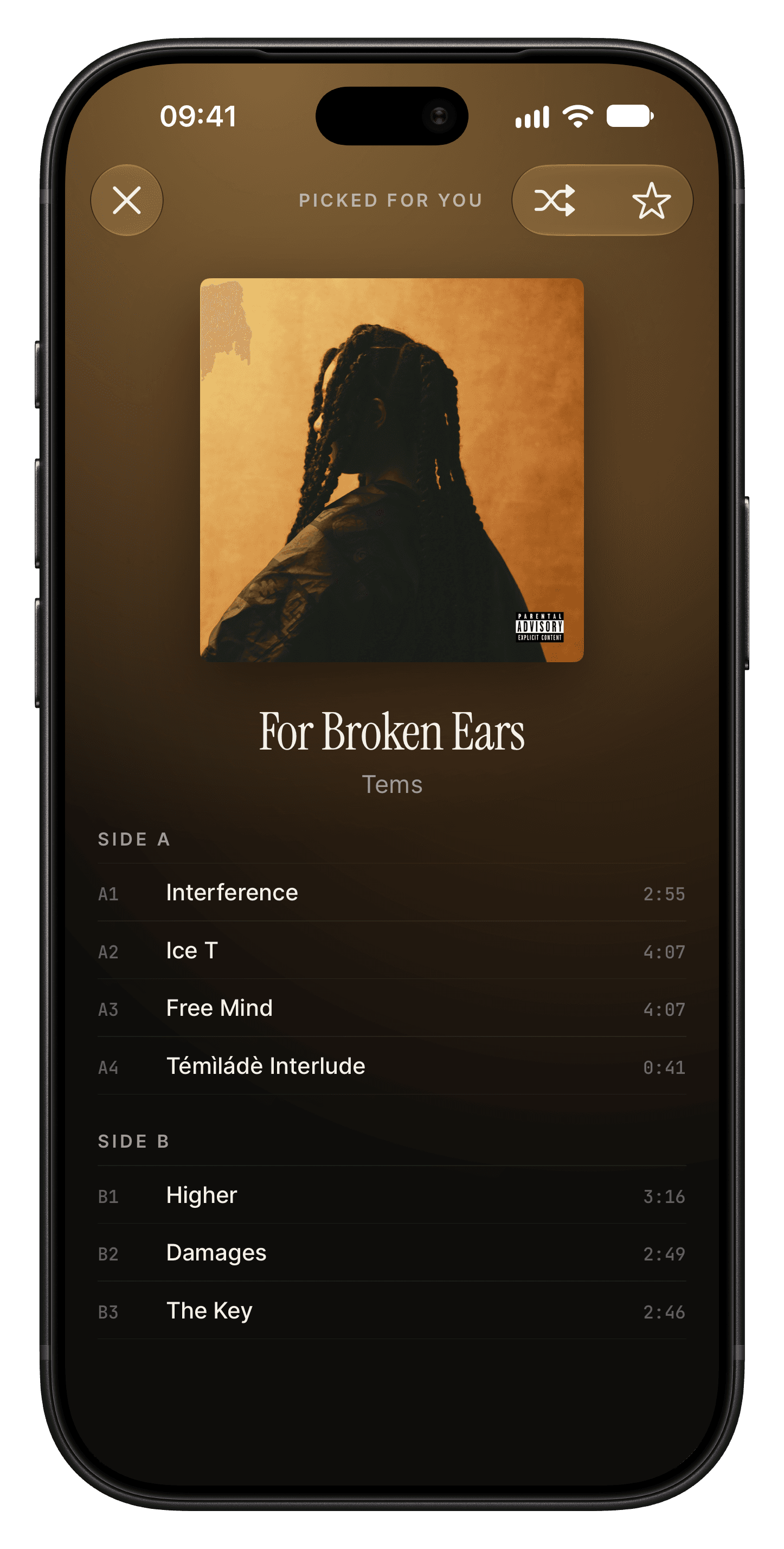
When nothing is playing yet, shake your iPhone, tap Pick for me, or ask Siri "What should I play on Analog?", and Analog picks one record for right now. On a Mac, Pick for Me is in the Listen menu. It weighs much of what this article suggests, and a few things more. A record you've already played today stays out. If a record has just finished, its artist is out too, and the records you've put on after it before come first, then ones that share its style, its label or its decade. It leans toward what you tend to play at this time of day, gives the records that have waited a turn, and then lets chance choose among the ones that fit. Shake again and you get a different record. It doesn't need Apple Intelligence, so it works on any device that runs Analog.
Both get better the more you play, because Analog keeps the log for you: every side it identifies goes into History, so it knows what's been on the turntable lately and what hasn't. Play Next, Pick for me, the identification, History and the Apple Watch app are all free. Analog won't know your mood, and it can only choose from what's in your Discogs collection, so it's only as good as your catalog: the guide to cataloging a collection on Discogs is the place to start if yours is incomplete.
Tonight
If you only take one thing to the shelf, take the record you just played and ask what it has in common with something you haven't heard in a while. That's usually enough to find it. And if you end up putting on one of the usual ten anyway, that's fine too. They're the usual ten for a reason.